An automated pipeline reads public incident news every day. Claude groups duplicate reports, separates facts from inference, writes direct / indirect / root causes and prevention steps, and cites Taiwan regulations — every article number is hard-checked against the official law database before publishing. Posters are in Traditional Chinese for Taiwanese site crews.
21incidents published
14fatal incidents
17with verified posters
Sep 23 – Oct 82026 · updated daily
Facts come from the linked public news reports. Items marked “(inferred)” are the model's reasoning, not official findings. Names of victims are removed. Analysis and poster text are written by Claude and translated to English by Claude; poster illustrations are rendered by a separate image model. Every entry is pending human review.
Type
Region
Severity
🟠 Serious / multiple injuriesCaught in machineryInternationalManufacturingSource: HSE (UK)
UK sheet-metal plant welder moving a 133 kg hopper side panel alone has right hand crushed as panel slides off, loses part of thumb
2024-10-24 · A sheet-metal fabrication plant (Malvern Mill) in Nelson, Lancashire, UK · 1 seriously injured
At about 11:30 a.m. on 24 October 2024, Todd Marshall, a welder at a UK sheet-metal fabrication company, was welding a large stainless-steel hopper on his own. After finishing each side, he had to lift the side panel and reposition it. One 133 kg hopper side panel was suspended in mid-air with its smaller end resting on a smooth worktable. The panel slid across the tabletop and fell onto his hand, crushing it and causing him to lose part of his right thumb. His age was not stated in reports. The UK Health and Safety Executive (HSE) investigation found that an almost identical incident had happened only a few days earlier. The company had no risk assessment and no safe system of work for this task, and had given workers no clear instructions for it. On 6 October 2026, Warrington Magistrates' Court sentenced the company after it pleaded guilty to breaching Regulation 4(1) of the Manual Handling Operations Regulations 1992. It was fined £48,000 and ordered to pay costs of £10,089.
Causes (direct / indirect / root)
[Direct] The 133 kg side panel had one end suspended and the other resting on a smooth tabletop, and was not secured with clamps or stops (unsafe condition)
[Direct] The worker moved and repositioned the heavy part alone, with his hand inside the area where the load could fall (unsafe act)
[Indirect] No mechanical aids such as a crane, lifting gear or turning jig were used to move the heavy part (inferred)
[Indirect] No review or improvement was made after a nearly identical incident a few days earlier
[Root] The company did not carry out a risk assessment for moving the hopper side panels and did not set a safe system of work
[Root] Workers were not given clear work instructions or training
Prevention
Use a crane, lifting gear or turning jig to reposition heavy parts, replacing manual effort with machinery
Fit anti-slip mats, stops or clamps to worktables, and secure heavy parts before working while they are suspended
Have at least two people reposition heavy parts, with one person designated to direct the work; prohibit working alone
Set a standard operating procedure, include it in the safety and health work rules, and provide training before the work starts
After a near miss or similar incident, investigate immediately and correct the work method
Regulations (article numbers verified against Taiwan's law database)
Occupational Safety and Health Facilities Rules (職業安全衛生設施規則) Art. 155: Materials handling should use machinery instead of manual labour as far as possible, and items of 40 kg or more should be moved with hand carts or tools. In this case, the worker moved and repositioned the 133 kg side panel alone by hand.
—— For the handling of materials, employers shall use machinery in place of manual labour as far as possible. As a rule, items of 40 kg or more shall be moved with hand carts or tools, and items of 500 kg or more should preferably be moved with powered vehicles or other machinery. Transport routes shall be properly planned and marked.
Occupational Safety and Health Education and Training Rules (職業安全衛生教育訓練規則) Art. 17: Employers shall give workers general safety and health training suited to their work. In this case, the worker had not received clear instructions on how to do this task safely.
—— Employers shall provide newly hired workers, and current workers before they change jobs, with the general safety and health education and training required for that work. This does not apply where the working environment and nature of the work are equivalent to those before the change.
Workers without a fixed employer, and other persons who work under the direction or supervision of the person in charge of the workplace, shall receive the safety and health education and training referred to in the preceding paragraph.
The courses and hours of the training in the two preceding paragraphs are set out in Schedule 14.
Where workers of a business unit complete online occupational safety and health training courses designated by the central competent authority and obtain certified hours, these may be recognised as general safety and health training hours. However, for online courses approved by the central competent authority, at most two hours may be recognised.
Workers referred to in paragraphs 1 and 2 who have passed construction safety training under Art. 11-2 of the Construction Safety and Health Facilities Standards (營造安全衛生設施標準) before working at a construction site may be exempted from the training in paragraph 1.
Occupational Safety and Health Act (職業安全衛生法) Art. 34: Employers shall set safety and health work rules (including work procedures) and announce and implement them. In this case, there was no safe system of work at all for this task.
—— Employers shall, together with workers' representatives and in accordance with this Act and related regulations, set safety and health work rules suited to their needs, submit them to the labour inspection authority for record, and then announce and implement them.
Workers shall strictly follow the safety and health work rules referred to in the preceding paragraph.
🔴 FatalFall from heightInternationalConstructionSource: HSE (UK)
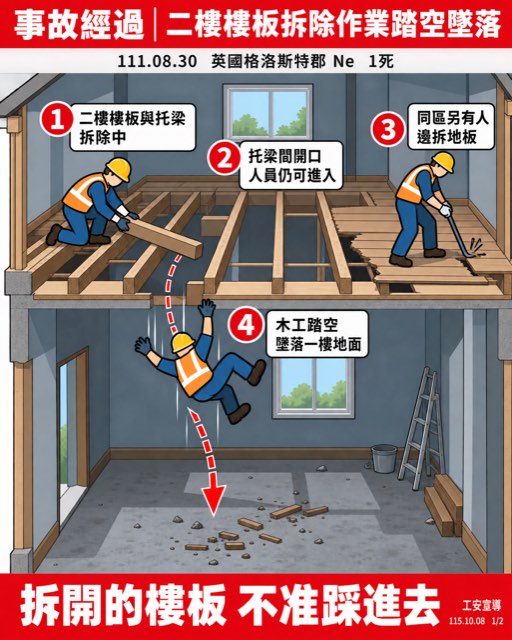
UK house first-floor renovation: carpenter falls to his death through a floor that was being stripped out
2022-08-30 · A residence (Manor Barn House) in Nether Westcote, Gloucestershire, UK · 1 dead
On 30 August 2022, an Oxfordshire construction company was carrying out a major renovation of the upper floor of a house (the 'first floor' in British usage). The work involved replacing rotten floor joists and floorboards. A 59-year-old carpenter, Richard Roper, was replacing damaged joists. In the same area, other workers were removing floorboards. Large sections of the floor structure had been opened up, leaving gaps between joists, and some joists were missing or not secured. He stepped through the unsafe floor and fell onto the concrete floor of the ground floor below. He suffered serious head injuries and died in hospital the next day. Reports did not state the height of the fall. The UK Health and Safety Executive (HSE) investigated. It found that the work at height had not been properly planned, supervised or carried out. People could still enter areas where the floorboards and supports had been removed, and fall prevention measures were inadequate. HSE issued a Prohibition Notice on the spot to stop the work at height. On 24 September 2026, Bristol Magistrates' Court sentenced the company after it pleaded guilty to breaching Regulation 4(1) of the Work at Height Regulations 2005. It was fined £120,000 and ordered to pay costs of £5,247.
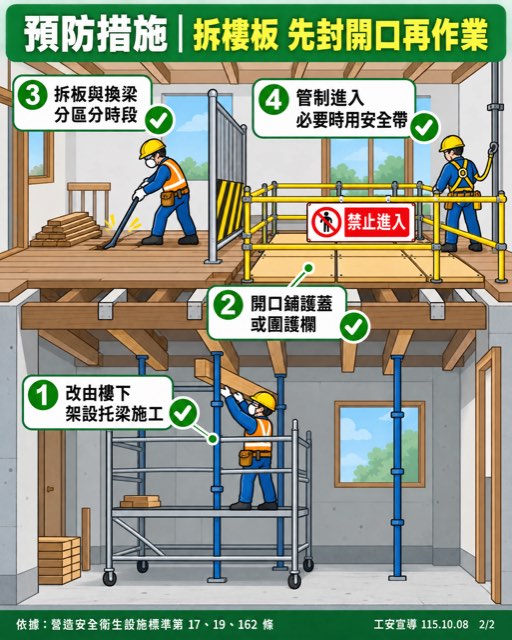
1/2 What happened2/2 Prevention
Causes (direct / indirect / root)
[Direct] The floor and joists had been partly removed. There were gaps between joists, and some joists were missing or not secured, creating openings that people could fall through (unsafe condition).
[Direct] The carpenter stepped into an opening while working on the opened-up floor and fell (unsafe act).
[Indirect] Floorboard removal and joist replacement were carried out at the same time in the same area, so the openings kept getting larger.
[Indirect] Workers could freely enter the stripped-out area. No covers or guardrails were fitted, and access was not restricted (inferred; HSE stated only that fall prevention measures were inadequate).
[Root] The method for the work at height was not planned in advance. Methods that avoid working at height, such as working from the floor below, were not given priority.
[Root] Site supervision was inadequate. No risk assessment was carried out for the floor removal work, and no fall prevention plan was put into practice.
Prevention
Change the work method first: replace joists from the floor below using scaffolding or a mobile elevating work platform, so fewer workers stand on a floor that is being dismantled.
As soon as the floor is opened up, cover the openings with covers strong enough to take the load, or fit guardrails along the edges of the openings.
Separate floorboard removal and joist replacement by area and by time, so openings are not enlarged in the same area at the same time.
Close off stripped-out areas with barriers or barrier tape and keep out anyone not involved in the work. Where protection cannot be installed, workers should wear safety harnesses attached to anchor points.
Before work starts, carry out a fresh risk assessment based on the construction plan, and assign a designated person to supervise on site.
Regulations (article numbers verified against Taiwan's law database)
Construction Safety and Health Facilities Standards (營造安全衛生設施標準) Art. 17: For work at a height of 2 m or more, employers must draw up a fall prevention plan and should first choose work methods that let workers do the job at ground level. In this case there was no plan, and the carpenter replaced joists while standing on a floor that was being dismantled.
—— Where workers at a workplace 2 metres or more in height are at risk of falling, the employer shall draw up a fall prevention plan. The employer shall plan according to the following order of risk control and adopt appropriate fall prevention facilities:
1. Through design or choice of work method, have workers complete work at ground level as far as possible, reducing the number of work-at-height tasks.
2. Through changes to the construction sequence, give priority to installing permanent access equipment or fall prevention facilities.
3. Install guardrails and covers.
4. Install safety nets.
5. Set up a warning line system.
6. Restrict workers from entering controlled areas.
7. Have workers wear safety harnesses.
8. Where open edges, formwork, finishing work, etc., or the facilities required under items 1 to 4 increase the danger of the work, draw up and implement a protection plan.
Construction Safety and Health Facilities Standards Art. 19: Where there is a risk of falling through an opening, guardrails, covers or safety nets must be installed. Where these cannot be installed, safety harnesses must be used. In this case, no effective protection was seen at the openings between joists.
—— Where workers working at roofs, steel beams, openings, steps, stairs, ramps, work platforms, retaining walls, earth-retaining supports, construction stages, bridge piers and columns, bridge superstructures, abutments or similar places 2 metres or more in height are at risk of falling, the employer shall install guardrails, covers, safety nets or other protective equipment at those places.
Where it is difficult for the employer to install the equipment in the preceding paragraph, or where guardrails, covers, safety nets or other protective equipment are temporarily opened or removed because the work requires it, the employer shall take fall prevention measures such as having workers use safety harnesses. However, once the reason for the difficulty no longer exists, the employer shall comply with the preceding paragraph.
Construction Safety and Health Facilities Standards Art. 162: During floor demolition, or where workers must walk across the work area, measures must be taken to prevent people from falling, and guardrails must be installed at the edges of openings. In this case, workers were still walking and working on the floor while it was being removed.
—— When demolishing floor slabs, bridge deck slabs or similar structures, the employer shall comply with the following:
1. During demolition, or where workers must walk across the work area, take measures to prevent people from falling and objects from flying or falling.
2. Install guardrails at the edges of openings through which demolished material is lowered.
3. After floor slabs, bridge deck slabs, etc. are demolished, put barriers around the area below.
Construction Safety and Health Facilities Standards Art. 6: Before work starts at a construction site, a further risk assessment must be carried out and suitable protection put in place. In this case, the fall risk in the demolition area was not properly assessed.
—— Before having workers work at a construction site, the employer shall assign its own occupational safety and health personnel, the person in charge of the workplace, full-time engineering staff or other professionals, or engage a professional body, to carry out a further risk assessment. This assessment shall be based on the risk assessment from the construction planning stage, the construction plan and other information. The employer shall then put suitable protective facilities in place to prevent occupational accidents.
Where a construction plan is required under building regulations or similar rules, the protective facilities in the preceding paragraph shall be included in the construction plan and implemented.
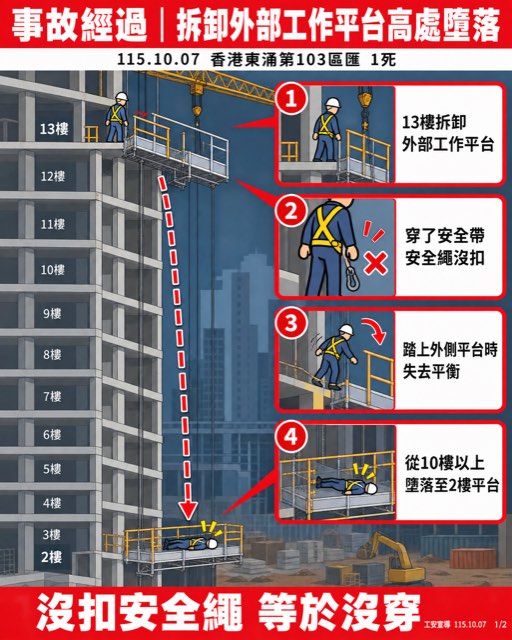
Hong Kong Tung Chung public housing site: worker dismantling external working platform falls from height and dies with safety lanyard not clipped on
2026-10-07 · Public housing development project site, Wui Tung Street, Area 103, Tung Chung, Hong Kong · 1 dead
At about 1:40 p.m. on 7 October 2026, at the public housing development project site on Wui Tung Street, Area 103, Tung Chung, Hong Kong, a 34-year-old male worker (described by Now News as a crane worker) was dismantling an external working platform on the 13th floor. As he stepped onto the outer platform, he lost his balance, fell from above the 10th floor and landed on the 2nd-floor working platform. According to reports, he was wearing a safety harness but had not clipped his safety lanyard to a safety hook (anchor point). He was taken unconscious to North Lantau Hospital for emergency treatment and was certified dead at about 2:00 p.m. Police classified the case as an industrial accident, and the Labour Department sent officers to investigate at the scene. The Association for the Rights of Industrial Accident Victims said this was the 6th fatal accident this year involving a government works project. Reports did not state the contractor's name or the platform type.
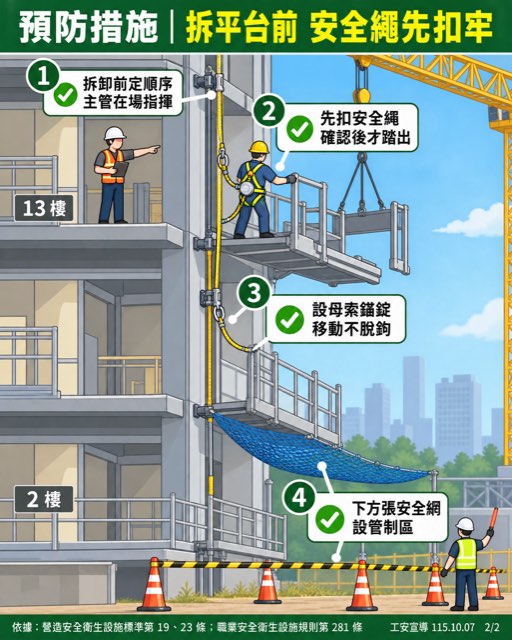
1/2 What happened2/2 Prevention
Causes (direct / indirect / root)
[Direct] Although the worker was wearing a safety harness, his safety lanyard was not clipped to a safety hook (anchor point), so nothing arrested his fall
[Direct] He lost his balance while stepping onto the outer working platform
[Indirect] Edge protection on the external working platform being dismantled may already have been partly removed, exposing workers to an open edge (inferred)
[Indirect] No one on site confirmed that the worker had clipped on before he stepped out (inferred)
[Root] The dismantling procedure did not make "clip on first, then move" a control point, and it was not enforced through supervision (inferred)
[Root] The dismantling work did not plan enough anchor points or lifelines in advance to let workers stay clipped on at all times (inferred)
Prevention
Engineering control: Before dismantling an external working platform, install anchor points or vertical/horizontal lifelines that are independent of the platform being dismantled, and hang safety nets on the floors below
Engineering control: Use a full-body harness with a self-retracting lifeline; when moving, use twin hooks to switch attachment points so the worker is never unhooked
Management: Before dismantling, prepare a fall-prevention plan and a dismantling sequence; have the work supervisor on site to direct the work, and allow workers to step out only after clip-on is confirmed
Management: Inspect harnesses, lanyards and anchors before work, and use mutual clip-on checks between workers
Management: Set up warning signs and a controlled zone below the dismantling area, and keep out anyone not involved in the work
Regulations (article numbers verified against Taiwan's law database)
Construction Safety and Health Facilities Standards (營造安全衛生設施標準) Art. 17: Where work at a height of 2 m or more poses a fall risk, a fall-prevention plan must be prepared, and measures such as guardrails, safety nets and safety harnesses must be applied in order of priority. In this case, dismantling the external platform was work at height, and fall-prevention measures were not properly implemented.
—— Where workers at a workplace 2 meters or more in height are at risk of falling, the employer shall prepare a fall-prevention plan, plan according to the following order of risk control, and adopt appropriate fall-prevention facilities:
1. Through choice of design or construction method, have workers complete work on the ground as far as possible, reducing work-at-height items.
2. Through changes to the construction sequence, give priority to building the access equipment or fall-prevention facilities of permanent structures.
3. Install guardrails and covers.
4. Hang safety nets.
5. Install a warning line system.
6. Restrict workers from entering controlled zones.
7. Have workers wear safety harnesses.
8. Where open edges, formwork, finishing work, or the use of the facilities in items 1 to 4 increase the danger of the work, a protection plan shall be prepared and implemented.
Construction Safety and Health Facilities Standards Art. 19: Where guardrails or other protection are temporarily removed because the work requires it, workers must use safety harnesses to prevent falls. In this case, the worker did not clip on his safety lanyard while dismantling the platform.
—— Where workers working on roofs, steel beams, openings, steps, stairs, ramps, work platforms, retaining walls, earth-retaining supports, construction platforms, bridge piers and superstructures, abutments or similar places at a height of 2 meters or more are at risk of falling, the employer shall install guardrails, covers, safety nets or other protective equipment at those places.
Where it is difficult for the employer to install the equipment in the preceding paragraph, or where guardrails, covers, safety nets or other protective equipment are temporarily opened or removed because the work requires it, the employer shall take fall-prevention measures such as having workers use safety harnesses. However, once the reason for the difficulty no longer exists, the preceding paragraph shall apply.
Construction Safety and Health Facilities Standards Art. 23: Safety harnesses must be attached to anchors or lifelines able to withstand 2,300 kg per person, and workers must switch hooks when moving. In this case, the safety lanyard was not clipped to any anchor.
—— When the employer provides safety harnesses for workers or installs lifelines, the following shall apply:
1. The material, strength and testing of safety harnesses shall comply with national standards CNS 7534 Safety belts for work at height, CNS 6701 Safety belts (body-belt type), CNS 14253 Harness-type safety belts, CNS 14253-1 Full-body harnesses, and CNS 7535 Test methods for safety belts for work at height.
2. Lifelines may be made of steel wire rope, nylon rope or synthetic fiber, with a minimum breaking strength of 2,300 kg or more.
3. Anchors to which safety harnesses or lifelines are attached shall withstand a pulling force of at least 2,300 kg per person.
4. Harness lanyards or lifelines shall be protected from cutting or abrasion.
5. Safety harnesses or lifelines shall not be hooked or tied to guardrail members, unless those members meet the strength requirement in item 3.
6. Safety harnesses, lifelines and their fittings and anchors shall be inspected before use or after bearing an impact; any with wear, deterioration, defects, or strength not meeting items 1 to 3 shall not be used again.
7. Safety harnesses that require an auxiliary rope to move during work shall have an auxiliary hook so workers can switch hooks while moving. This does not apply where horizontal movement is unobstructed and no unhooking is needed midway.
8. Horizontal lifelines shall be installed as follows:
(1) The installation height of a horizontal lifeline shall be greater than 3.8 meters; the maximum spacing between two adjacent anchor points may be calculated by the formula below, and if the calculated value exceeds 10 meters, 10 meters shall be used:
L=4(H-3),
where H≧3.8 and L≦10
L: spacing between lifeline anchor points (unit: meters)
H: vertical clearance height (unit: meters)
(2) Only one safety harness may be attached to the lifeline between an anchor point and another attachment point, between two adjacent anchor points, or between lifeline anchor points.
(3) The number of safety harnesses that may be attached to each lifeline shall be marked at the anchor end of the lifeline.
9. Vertical lifelines shall be installed as follows:
(1) The lower end of the lifeline shall have a device to prevent the harness fastener from slipping off the end.
(2) Each lifeline shall be used by only one worker, except that two workers may share one lifeline where the horizontal distance between their work or climbing positions is 1 meter or less.
Occupational Safety and Health Facilities Rules (職業安全衛生設施規則) Art. 281: For work at a height of 2 m or more, workers must properly use safety harnesses, and assembly or dismantling of work platforms requires a full-body harness with a self-retracting lifeline. In this case, the worker wore a harness but did not properly use it.
—— For work at a height of 2 meters or more where workers are at risk of falling, the employer shall have workers properly use safety harnesses, safety helmets and other necessary protective equipment, unless the employer has adopted measures such as safety nets.
For the use of safety harnesses under the preceding paragraph, an appropriate type shall be selected according to national standards based on the nature of the work. For movement at height or on inclined surfaces, such as on steel cantilever projections, inclined scaffolds, fixed vertical ladders of 2 meters or more without cages or similar protective devices, confined spaces, roof or scaffold assembly and dismantling, work platform assembly and dismantling, and pipeline maintenance, a full-body harness meeting national standard CNS 14253-1 or equivalent and a self-retracting lifeline shall be used.
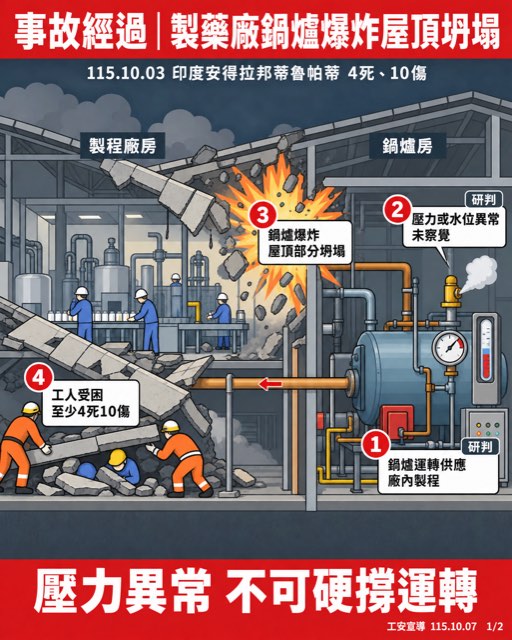
Boiler explosion at pharmaceutical plant in Sri City, India: partial roof collapse leaves 4 dead, 10 injured
2026-10-03 · Private pharmaceutical plant, Sri City Special Economic Zone, Tirupati District, Andhra Pradesh, India · 4 dead, 10 injured
On the morning of 3 October 2026, a boiler exploded at a private pharmaceutical plant in the Sri City Special Economic Zone, Tirupati District, Andhra Pradesh, India. At least 4 workers were killed and 10 were injured. The explosion caused part of the plant roof to collapse, briefly trapping several workers. Firefighters, police and rescue teams arrived to put out the fire, search for victims and evacuate the injured. The fire was brought under control, and the injured were taken to nearby hospitals. The exact cause is still under investigation. Authorities are looking into equipment failure and other possible factors, and the Chief Minister of Andhra Pradesh has ordered a detailed investigation. Reports did not state the boiler type, pressure, operating personnel or inspection records.
1/2 What happened2/2 Prevention
Causes (direct / indirect / root)
[Direct] The boiler exploded (fact); the exact cause is under investigation. Possible causes include overpressure with a failed safety valve, or water being fed in after the boiler ran dry at low water level (inferred)
[Direct] The blast caused part of the plant roof to collapse, trapping workers (fact)
[Indirect] Abnormal pressure, water level or other conditions were not detected or dealt with in time (inferred)
[Indirect] The boiler room was not effectively separated from work areas, so the blast affected nearby workers (inferred)
[Root] Periodic boiler inspections, safety device maintenance and the inspection certification system were not properly carried out (inferred)
[Root] Operator qualifications, training and emergency shutdown procedures were inadequate (inferred)
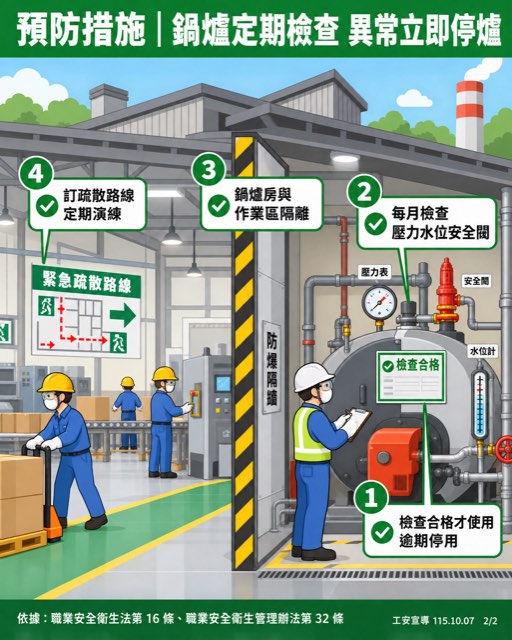
Prevention
Engineering controls: Keep boiler safety valves, pressure gauges, water level gauges and low-water fuel cut-off devices in working order, and test their operation regularly
Engineering controls: Separate the boiler room from work and rest areas with blast walls or sufficient distance to reduce the number of people exposed to an explosion
Management: Use a boiler only after it has passed inspection; once the certification period expires, do not continue using it until it passes re-inspection
Management: Carry out monthly periodic boiler inspections as required and keep records; shut down the boiler immediately for repair if any abnormality is found
Management: Have boilers operated only by qualified operators, set procedures for shutdown and reporting when pressure or water level is abnormal, and hold regular evacuation and rescue drills
Regulations (article numbers verified against Taiwan's law database)
Occupational Safety and Health Act (職業安全衛生法) Art. 16: Designated hazardous machinery or equipment (including boilers) must not be used unless it has passed inspection, and must not continue in use after the certification period expires unless it passes re-inspection. Had this occurred in Taiwan, the boiler would have needed confirmed inspection certification before operation.
—— Employers shall not use machinery or equipment designated as hazardous by the central competent authority unless it has passed inspection by a labor inspection agency or an inspection agency designated by the central competent authority to inspect on its behalf. Where such machinery or equipment is used beyond the prescribed period, it shall not continue to be used unless it passes re-inspection.
Designated inspection agencies shall perform their duties in accordance with this Act and the orders issued under it.
The standards for inspection fees, and the qualifications and responsibilities of designated inspection agencies, shall be prescribed by the central competent authority.
Regulations on the types and required capacities of the hazardous machinery or equipment referred to in paragraph 1, as well as the procedures, items and standards for manufacturing-process, completion, use, modification and other inspections, and the validity period of inspection certificates, shall be prescribed by the central competent authority.
Occupational Safety and Health Management Regulations (職業安全衛生管理辦法) Art. 32: Boilers must be inspected monthly, covering the boiler body, combustion equipment and automatic control devices (including fuel cut-off, water level and pressure regulation). This explosion suggests that inspection and maintenance of safety and control devices may have been inadequate.
—— Employers shall carry out a periodic inspection of boilers once a month covering the following:
1. Whether the boiler body is damaged.
2. Combustion equipment:
(1) Whether oil heaters and fuel feed equipment are damaged.
(2) Whether burners are damaged or dirty.
(3) Whether filters are clogged or damaged.
(4) Whether burner ceramic parts and furnace walls are dirty or damaged.
(5) Whether stokers and grates are damaged.
(6) Whether flues show leakage, damage or abnormal draft pressure.
3. Automatic control devices:
(1) Whether automatic start/stop devices, flame detectors, fuel cut-off devices, water level regulators and pressure regulators function abnormally.
(2) Whether electrical wiring terminals show any abnormality.
4. Auxiliary equipment and accessories:
(1) Whether feedwater equipment is damaged, and its operating condition.
(2) Whether steam pipes and stop valves are damaged, and the condition of their insulation.
(3) Whether air preheaters are damaged.
(4) Whether water treatment equipment functions abnormally.
Occupational Safety and Health Facilities Rules (職業安全衛生設施規則) Art. 104: Boiler and pressure vessel equipment and related measures must comply with the safety rules for boilers and pressure vessels. Had this occurred in Taiwan, the installation, operation and safety devices of the boiler would all have had to meet these specific rules.
—— Employers shall handle boiler and pressure vessel equipment and related measures in accordance with the relevant safety rules for boilers and pressure vessels.
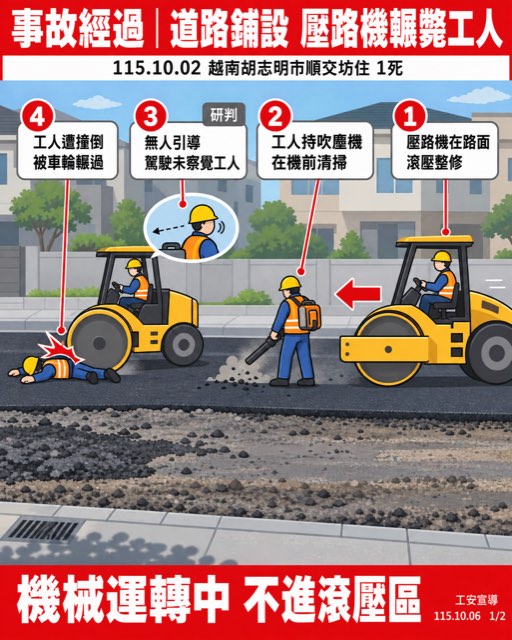
Vietnam road paving project: worker cleaning road surface with a dust blower struck and crushed to death by a road roller
2026-10-02 · D7 road renovation site in a residential area, Thuan Giao Ward (formerly Thuan An City, Binh Duong Province), Ho Chi Minh City, Vietnam · 1 dead
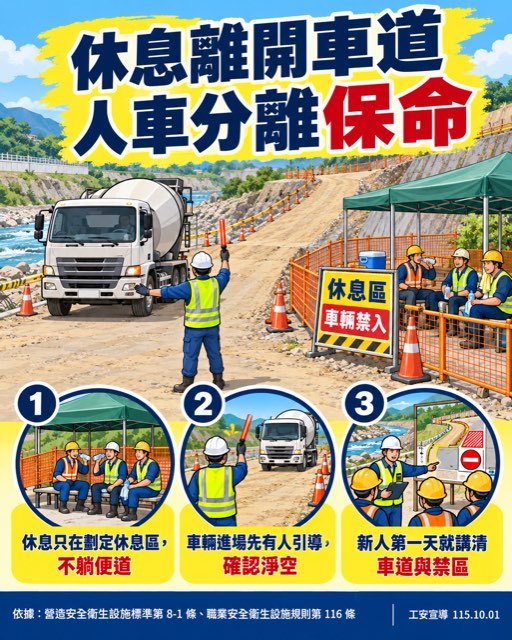
At about 7:30 a.m. on October 2, 2026, the D7 road renovation project in a residential area of Thuan Giao Ward (formerly Thuan An City, Binh Duong Province), Ho Chi Minh City, Vietnam, was carrying out finishing work before asphalt paving. A 42-year-old temporary worker was cleaning the road surface with a handheld dust blower when a road roller operated by a 25-year-old driver struck him from behind. He fell and was run over by the roller's wheel, dying at the scene. The road renovation had been under way for weeks to months, and reports said the workers were rushing to complete the final stage. Local police cordoned off the scene for inspection, reviewed surveillance footage and questioned those involved to determine the cause. Reports did not state whether the roller was moving forward or reversing, or its speed.
1/2 What happened2/2 Prevention
Causes (direct / indirect / root)
[Direct] The worker was working in the travel path ahead of an operating road roller, inside the machine's danger zone
[Direct] The driver did not notice the worker ahead (inferred), and the roller kept moving, knocking down and running over the worker
[Indirect] Cleaning (dust blowing) and rolling were carried out on the same road section at the same time without separation (inferred)
[Indirect] No traffic controller/banksman or warnings were in place on site, and the worker, with his back to the machine, could not move away in time (inferred)
[Indirect] Rushing to finish the work sped up the pace and reduced alertness (inferred)
[Root] Separation of machine and worker routes and work sequencing was not planned in advance (inferred)
[Root] Insufficient machinery-hazard training and pre-task hazard briefing for temporary workers (inferred)
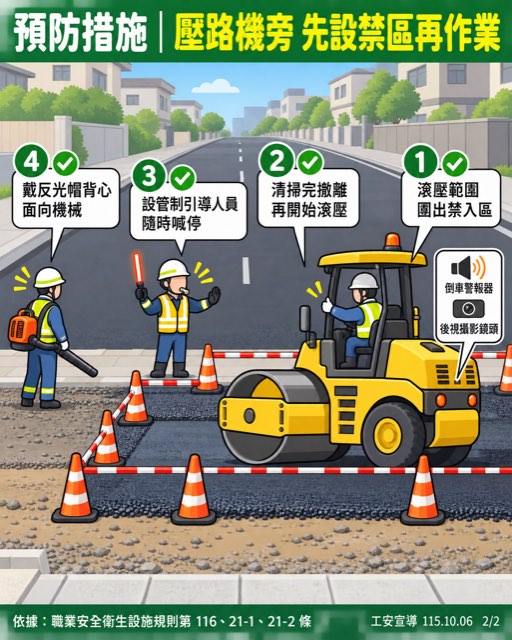
Prevention
Engineering controls: mark off a no-entry zone around rolling operations with traffic cones, barrier bars or fencing; fit road rollers with reversing alarms and rear-view cameras / person-detection devices
Work planning: start rolling only after cleaning (dust blowing) is finished and workers have left; never allow workers and the roller to work on the same road section at the same time
Management: when moving machinery could strike workers, assign a traffic controller/banksman who confirms with the driver using hand signals and a whistle and calls an immediate stop if anyone enters the zone
Management: for work on roads, set up traffic control devices according to the traffic management plan and designate a person to manage signs and barriers
Training: give a pre-task hazard briefing that clearly tells temporary workers the extent of the rolling zone and the driver's blind spots, and that they must never work with their back to operating machinery
PPE: all workers must wear safety helmets with reflective strips and brightly colored reflective vests so drivers can see them easily
Regulations (article numbers verified against Taiwan's law database)
Occupational Safety and Health Facilities Rules (職業安全衛生設施規則) Art. 116: Item 3 prohibits persons from entering the operating radius of vehicle-type construction machinery or nearby places where there is a risk of danger; Item 15 requires a traffic controller/banksman when moving machinery could strike workers. In this case, the worker was cleaning in front of a moving road roller with no one guiding traffic.
—— For vehicle machinery working at a workplace, the employer shall have the driver or relevant persons be responsible for the following:
1. The machine shall not be started unless all persons are clear of it, except where the driver is in position as required.
2. Vehicle-type construction machinery and forklifts shall not carry workers during operation except in the seating positions.
3. During operation of vehicle-type construction machinery, persons shall be prohibited from entering the operating radius or nearby places where there is a risk of danger, except where the driver is in position as required or other safety measures are taken.
4. Care shall be taken to keep away from live conductors to prevent electric shock.
5. Operation shall follow the safety factor, maximum working load and other specifications set by the manufacturer.
6. Parking on slopes where there is a risk of sliding is prohibited, except where other equipment or measures have been adopted.
7. Parking on major traffic routes at night is prohibited.
8. Powered excavating machinery shall not travel with a load in its shovel, grab, bucket, etc.
9. Vehicle machinery shall not be used for purposes other than its main purpose, except where a device suitable for that purpose is used and there is no risk of harm to workers.
10. Workers shall not ride on the pallets, skids or other parts of a forklift's load on the forks, or on any other part of the forklift (other than the seat).
11. When the driver leaves the position, the bucket or other working attachment shall be lowered to the ground, the engine shut off and braked, and the brakes set, to prevent the machine from running away.
12. When a forklift driver leaves the position, the forks, etc. shall be lowered to the ground and the engine shut off and braked.
13. During repair of vehicles and forklifts, or installation/removal of attachments, safety props, winches or other devices to prevent falling objects shall be used for booms, arms, lifting platforms and vehicle beds.
14. For seated counterbalance forklifts and side-loading forklifts, the worker driving shall properly wear the seat belt, except where the driver's seat has guards or other protective devices to prevent the driver from being crushed if the forklift tips over.
15. When the operation or movement of vehicle machinery could strike workers, a traffic controller/banksman shall be assigned.
Occupational Safety and Health Facilities Rules (職業安全衛生設施規則) Art. 21-2: Work using roads requires traffic control devices; workers must wear safety helmets with reflective strips and reflective work vests; road construction requires traffic safety protection devices or traffic controllers. If this had occurred in Taiwan, this road paving work would have had to comply with these requirements.
—— For workplaces where work is done using roads, to prevent hazards such as vehicles intruding, the employer shall:
1. For highway construction work, set up traffic control devices according to the traffic management plan approved by the local special municipality or county (city) government, or the drawings approved by the highway authority.
2. Have workers wear safety helmets with reflective strips and brightly colored work vests with reflective strips for visibility.
3. Prohibit vehicles unrelated to the work from parking in the work area, except standby vehicles needed for the work whose drivers remain on site.
4. At workplaces using roads, set up the vehicle entrance/exit at the rear relative to the traffic flow. Where this is difficult due to surrounding conditions, the entrance/exit may be set up parallel to traffic flow, with a traffic controller assigned to give general vehicles priority and avoid obstructing public traffic.
5. When workers carry out road excavation, construction, lifting/transport of construction materials, or road or roadside tree maintenance, set up traffic safety protection devices or traffic controllers at appropriate locations.
6. Where traffic controllers assigned under the previous two items and Item 8, Paragraph 1 of the preceding article are at risk of being struck, place an electric flagger with a brightly colored work vest, safety helmet and signal baton at a suitable distance in front of them.
7. Where lanes or shoulders are closed for more than two hours in the daytime or more than one hour at night, prepare a safety protection plan and assign a designated person to direct the work and confirm that control devices are installed according to the traffic management drawings.
Work using roads under the preceding paragraph does not include inspections, patrols, disaster relief and accident handling by the highway authority.
The safety protection plan under Item 7 of Paragraph 1 may be replaced by a traffic management plan prepared under highway authority rules; otherwise it shall include:
1. A traffic management layout drawing.
2. Possible hazards of the road work.
3. Measures to prevent those hazards.
4. Inspection and maintenance methods for protective and warning equipment provided.
5. Emergency response measures.
Occupational Safety and Health Facilities Rules (職業安全衛生設施規則) Art. 21-1: Workplaces with vehicle traffic or work using roads must have clear signals, signs or barriers, with a designated person in charge of them. In this case, there were no signs or barriers separating the rolling zone from the workers' area.
—— For workplaces with vehicles entering and leaving, work using roads, work adjacent to roads, or a risk of causing traffic accidents, the employer shall set up appropriate traffic signals, signs or barriers as follows:
1. Traffic signals and signs shall allow those being warned to clearly understand them.
2. A designated person shall be responsible for managing the control points of traffic signals, signs or barriers.
3. For new roads or roads under construction, signals, signs, barriers, reflectors, lighting or lamps shall be installed before opening to traffic.
4. Where permanent installations on a road are changed to temporary ones due to restrictive conditions, they shall be restored promptly once those conditions end.
5. Barriers used at night shall have lighting, reflective sheeting or similar devices.
6. Signal lights shall be erected on the right side of the road in a clearly visible location.
7. Supports for signals, signs or barriers shall have adequate strength.
8. Where signals, signs, barriers and similar devices are not enough to warn and prevent traffic accidents, traffic controllers shall be assigned.
Where the road traffic authority has regulations on the traffic signals, signs, barriers and similar devices in the preceding paragraph, those regulations shall apply.
🔴 FatalFall from heightTaiwanBuilding cleaning (exterior wall cleaning, working with a crane contractor)
Yilan Science Park office building exterior wall cleaning: crane overturns, basket falls, 1 dead and 1 injured
2026-10-03 · Phase 1 office building, Yilan Science Park, No. 15, Yike South Road, Yilan City, Yilan County · 1 dead, 1 injured
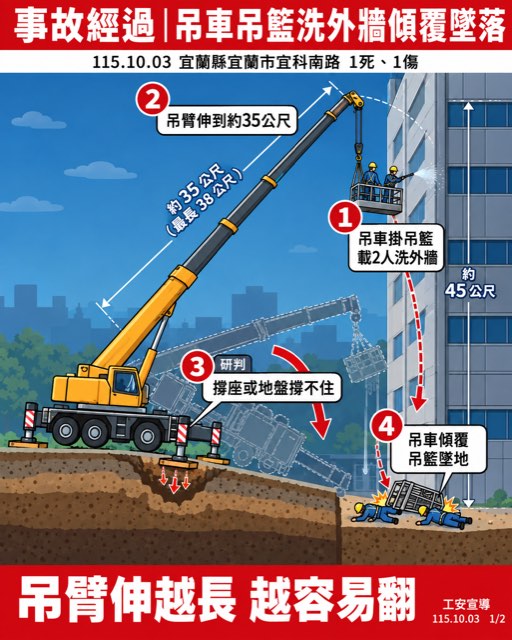
On the morning of 2026-10-03 (the fire department was notified at 8:49 a.m.), high-level exterior wall cleaning was under way at the Phase 1 office building in Yilan Science Park. Two workers were in a basket suspended from a large crane when the crane suddenly lost its balance and overturned. Both fell about 20 m to the ground. A 65-year-old worker was taken to National Yang Ming Chiao Tung University Hospital and died despite emergency treatment. The other worker suffered a fractured left thigh bone and remained conscious. News reports gave different surnames and ages, recorded as 65 or 63. According to reports, the building's exterior wall is about 45 m high. The crane's boom has a maximum length of 38 m and was extended to about 35 m at the time. The contractor said an added auxiliary boom section may have lengthened the boom and shifted the centre of gravity. Labour inspectors' initial finding pointed to a suspected mechanical failure of the boom. Other accounts cited failure of the hydraulic outriggers or insufficient ground bearing capacity. The cleaning company said its equipment and workers held the 'one machine, three certificates' credentials, and that workers wore lifting ropes and safety helmets. The Occupational Safety and Health Administration (OSHA) of the Ministry of Labor is leading the investigation. The Yilan County Government Labor Affairs Department attended the scene. Reports did not state whether a stop-work order was issued.
1/2 What happened2/2 Prevention
Causes (direct / indirect / root)
[Direct] The mobile crane was operated with its boom extended close to maximum length (about 35 m, possibly with an added auxiliary boom section). The large working radius exceeded the stable range and the crane overturned (contractor's account; cause pending OSHA investigation)
[Direct] Outriggers or hydraulic supports may have failed, or the ground bearing capacity may have been insufficient (news reports; inferred)
[Direct] Workers rode in a mobile crane basket at about 20 m height. When the crane overturned, the basket fell with it, so personal fall-protection equipment could not work (inferred)
[Indirect] Before work began, equipment with enough capacity for the wall height (about 45 m) was not selected. Purpose-built personnel equipment such as a gondola or aerial work platform was not used instead (inferred)
[Indirect] Before carrying personnel, a test lift at maximum load to maximum working height to confirm balance and stability was apparently not done (inferred)
[Indirect] No check was made that the combined load of the basket and workers stayed within 50% of the rated load for the working radius (inferred)
[Root] The cleaning company and crane contractor worked together, but responsibilities for the personnel-lifting work plan, risk assessment and chain of command were unclear (inferred)
[Root] Holding complete 'one machine, three certificates' credentials was treated as a substitute for real management, such as pre-work ground surveys, stability checks and pre-work inspections (inferred)
[Root] An older worker (65) was assigned to work at height with no evident targeted safety management (inferred)
Prevention
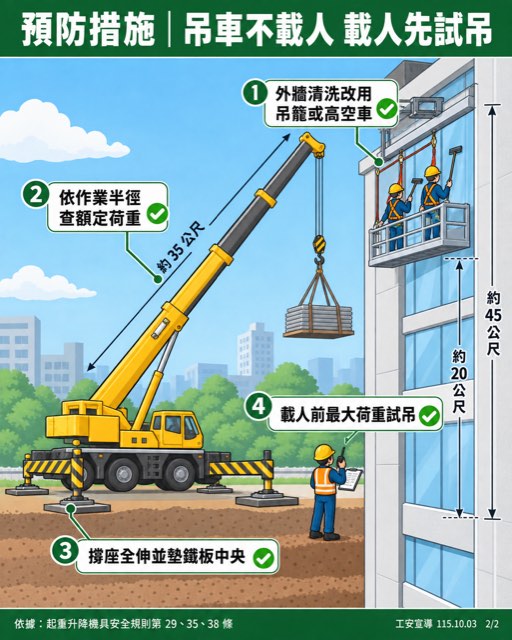
For exterior cleaning of tall buildings, use a fixed gondola or a certified aerial work platform first. Mobile cranes should normally lift loads only. Carrying people requires meeting the exception conditions and having fall-protection measures
Before work, survey the terrain, ground conditions and work space. Choose a crane with enough capacity for the wall height and working radius. Lay steel plates or packing on soft ground
Extend all outriggers to their maximum and place them at the centre of steel plates or packing. Confirm the overload prevention device works properly
Keep the combined load of the basket and workers within 50% of the rated load for the working radius. Before work, do a test lift at maximum load to maximum working height for at least 5 minutes, and repeat it whenever the crane is moved
Set out the working method, procedures and a safety checklist for personnel lifting. Assign a signal person. Carry out pre-work inspections and in-progress checks, and keep the records
Workers in the basket must wear full-body harnesses attached to a lifeline or fall-arrest system. The basket must not exceed its rated number of occupants
Regulations (article numbers verified against Taiwan's law database)
Safety Rules for Cranes and Hoisting Equipment (起重升降機具安全規則) Art. 35: Mobile cranes are limited to lifting loads and must not carry workers. Exceptions require a personnel-carrying device and fall protection, and the combined load of the device and workers must not exceed 50% of the rated load for the working radius. In this case a crane basket carried workers to clean an exterior wall, and the crane overturned with its boom extended close to its limit.
—— Employers shall use mobile cranes only for lifting loads and shall not use them to carry or lift workers for work. This does not apply where no other safe alternative method yet exists, such as container loading and unloading, ship repair or tall chimney construction, or where the work is temporary, small-scale, short-term or of a special nature, and measures such as fall prevention have been taken.
For the fall-prevention measures under the proviso of the preceding paragraph, employers shall do the following:
1. Carry or lift workers in a personnel-carrying device, and prevent it from tipping over or detaching.
2. Fit the personnel-carrying device with a lifeline or fall-arrest system, and have workers wear a safety helmet and a full-body harness meeting National Standard CNS 14253-1 or an equivalent or higher standard.
3. Do not exceed the rated number of occupants of the personnel-carrying device.
4. The maximum load, made up of the device's own weight plus occupants and materials, shall not exceed 50% of the rated load for the crane's working radius.
5. Lower the personnel-carrying device by powered descent.
6. For work at heights over 20 m vertically, do not use directly attached personnel-carrying devices, unless radio communication and work monitoring or collision-warning devices are provided.
Employers shall require crane operators to supervise occupants to ensure compliance with subparagraphs 2 and 3 of the preceding paragraph.
Safety Rules for Cranes and Hoisting Equipment Art. 38: Before carrying people in a suspended personnel-carrying device, a test lift at maximum load to maximum working height is required. The crane must stand on level, firm ground with all outriggers extended, and work procedures and checklists must be set. In this case, suspected outrigger failure or unstable ground led to the overturn.
—— When employers use a mobile crane with a suspended personnel-carrying device to carry or lift people, they shall do the following:
1. The personnel-carrying device and suspension gear (including welded, riveted and hinged parts) shall be properly designed for safety. Beforehand, the structural design drawings, strength calculations and construction drawings shall be submitted to a professional body recognised by the central competent authority for certification. Certification is valid for up to two years and must be renewed when it expires or the structure is changed.
2. Before carrying people, do a test lift with a load equal to the expected maximum load. Place the test load in the device, lift it to maximum working height, hold for at least five minutes, and confirm there is no problem with balance or safety. If the crane is moved to a new position, repeat the test lift.
3. Confirm that all of the crane's controls, anti-detachment devices, safety devices and brakes work properly. Confirm that the device's body, joints and fittings have no damage harmful to structural safety, and that slings and similar gear have no deformation, damage or kinks.
4. During operation, the crane shall stand on level, firm ground, and any outriggers shall be fully extended.
5. The crane shall not travel while carrying people. During raising and lowering, workers inside the device shall not lean out of it.
6. When carrying people, operate the crane at low speed and steadily, with no rapid or sudden movements. When the occupants reach the working position, the crane's hoisting, luffing, slewing and travel functions shall be securely locked by their brakes.
7. A signal person shall be assigned to direct personnel-lifting work. If no signal person can be assigned, radio communication or similar methods may be used instead.
For personnel-lifting work under the preceding paragraph, employers shall prepare in advance, based on the work's risk factors, the working method, procedures, safe work standards and a safety checklist, and have workers follow them.
Employers shall assign suitable personnel to carry out pre-work inspections, in-progress checks and self-inspections, and to monitor work safety at all times. The related forms and records shall be kept on file until the work is completed.
Safety Rules for Cranes and Hoisting Equipment Art. 29: The terrain, ground conditions and work space in the working area, and the crane's performance, must be surveyed in advance. Steel plates or packing must be laid where bearing capacity is insufficient, and outriggers used, to prevent overturning. Reports indicated the ground or supports may have been at fault.
—— To prevent hazards such as overturning, caught-in injuries and electric shock during mobile crane work, employers shall survey in advance the terrain, ground conditions and work space in the crane's working area, the weight of the loads, and the type, model and performance of the crane to be used. They shall then decide the following matters appropriately and take the necessary measures:
1. The mobile crane's working method, rigging method, transport route and similar matters.
2. For soft ground or other places with insufficient bearing capacity, use reinforcement methods such as laying steel plates or packing on the ground and using outriggers, to prevent the mobile crane from overturning.
3. Assign the duties of the crane operator, riggers, signal person and other workers involved, and set the chain of command.
For the mobile crane work in the first paragraph, employers shall take the following measures:
1. After deciding the matters in the preceding paragraph, inform the workers involved before work begins and have them follow them.
2. Confirm that the type and model of the mobile crane meet the needs of the work.
3. Check how the measures in the preceding paragraph are carried out. If any safety condition is not met, no lifting or rigging work shall be done until it is corrected.
For the mobile crane work in the first paragraph, employers shall do the following:
1. Survey in advance the on-site hazards, limits on use and work requirements, or require the party commissioning the work to provide this information, and confirm each item with a checklist.
2. Take the necessary preventive or corrective measures based on the survey results under the preceding subparagraph.
3. Keep the checklists, vehicle dispatch documents and other related records on file until the work is finished.
Safety Rules for Cranes and Hoisting Equipment Art. 32: Outriggers shall be extended to their maximum position. Where they cannot be fully extended, an overload prevention device must automatically reduce the rated load. In this case the boom was extended far, the working radius was large, and the crane lost stability.
—— When employers use a mobile crane with outriggers, or a crawler crane with extendable tracks, they shall extend the outriggers or tracks to their maximum position. Where a narrow work site, obstacles or other limits prevent this, the requirement does not apply if one of the following conditions is met and it can be confirmed that the suspended load is lighter than the rated load for the working radius:
1. The overload prevention device automatically lowers the set rated load according to the outrigger extension width.
2. The overload prevention device allows the outrigger extension width to be entered as a calculation factor, so that the set rated load is lowered.
3. The mobile crane's specification sheet or operating manual clearly states, for cases where the outriggers cannot be fully extended, a rated load chart or performance curve giving the lower rated loads for the corresponding partial outrigger widths.
Kaohsiung Luzhu semiconductor plant: hydrofluoric/nitric acid mixed waste liquid sprays during chemical piping work, 4 people burned
2026-10-02 · Semiconductor memory plant, Kaohsiung Park, Southern Taiwan Science Park, Luzhu District, Kaohsiung City · 4 injured
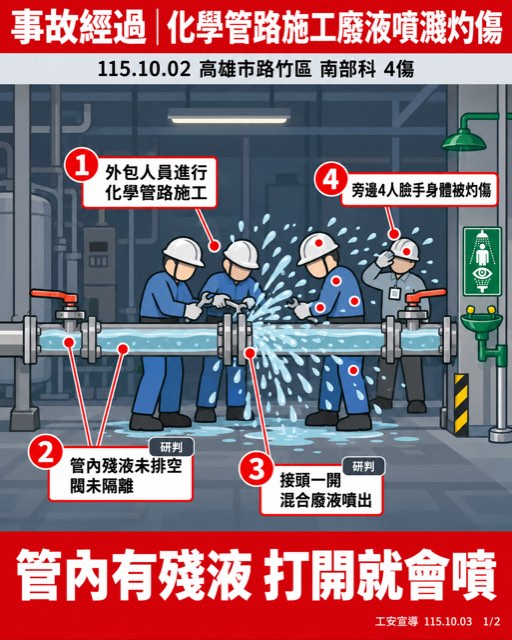
At about 11:21 a.m. on 2 October 2026, contractor workers doing chemical piping work at a semiconductor plant in the Kaohsiung Park of the Southern Taiwan Science Park in Luzhu District, Kaohsiung City, were sprayed with a mixed waste liquid of hydrofluoric acid and nitric acid, a mixture commonly called 'bone-dissolving water'. Four people were injured. Three were contractor workers: a 22-year-old man with injuries to the face, hands, chest and back; a 48-year-old man with injuries to the lower body; and a 29-year-old woman with an injury to the right forearm. The fourth was a 36-year-old male plant employee with an injury to the right forearm. They were taken to E-Da Hospital and Kaohsiung Veterans General Hospital. All were conscious on arrival and not in immediate danger of death. The fire department sent 14 vehicles and 34 personnel, and the Second Special Police Corps sent officers to investigate. Labor inspection authorities have stepped in to determine the cause of the accident and to check whether the contractor's work procedures, hazardous chemical management and protective measures complied with regulations. News reports did not state the exact cause of the spray, such as how the pipe was opened or whether it had been drained. The company said the cause is still being investigated.
1/2 What happened2/2 Prevention
Causes (direct / indirect / root)
[Direct] During chemical piping work, mixed hydrofluoric/nitric acid waste liquid remaining in the pipe sprayed out and contacted workers' skin (fact)
[Direct] The pipe was disassembled or cut before it had been properly drained, isolated or depressurized (inferred)
[Direct] Workers did not wear full-body protection adequate against corrosive liquids; injuries occurred to the face, chest, back and lower body (inferred)
[Indirect] Upstream and downstream valves were not double-closed or blinded, and were not locked out and tagged out, so waste liquid could still flow into the work section (inferred)
[Indirect] Before work began, nobody checked whether residual liquid was in the pipe, and the work method and sequence were not explained to workers in advance (inferred)
[Indirect] Nearby personnel, including a plant employee, were within the spray range because no restricted zone was set up (inferred)
[Root] When the company contracted out the work, it did not adequately inform the contractor of the hazards of the chemical piping and the measures required, and did not adequately supervise the work (inferred)
[Root] No designated person supervised the chemical equipment disassembly, and the work permit system was not properly enforced (inferred)
Prevention
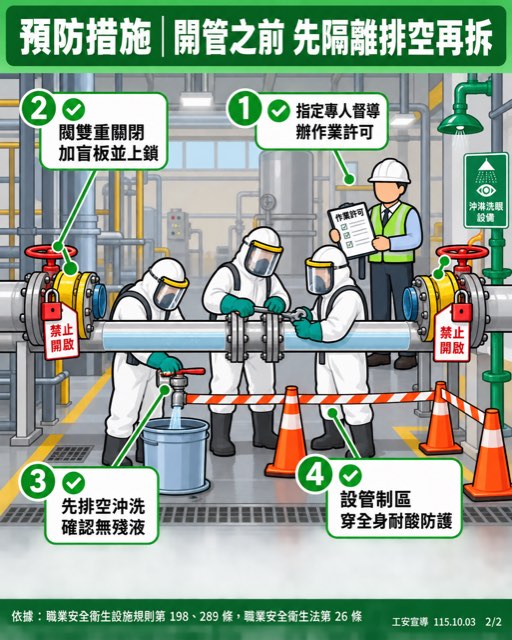
Before disassembling or cutting chemical piping, double-close the upstream and downstream valves or install blind flanges, then lock them out and hang 'Do Not Open' tags
Fully drain and depressurize the pipe section and flush it with water; before opening, confirm through the drain valve that there is no residual liquid and no pressure
Assign a designated person to supervise and issue a work permit; decide the work method and sequence in advance and explain them to all workers
Cordon off a restricted zone around the point where the pipe is opened; non-workers, including plant staff, must not enter the spray range
Workers must wear acid-resistant protective suits, face shields, goggles, acid-resistant gloves and boots; keep safety showers, eyewash stations and hydrofluoric-acid-specific first-aid treatment ready on site
Complete a risk assessment before contracting out work; inform the contractor in writing of the chemicals in the pipe, the risk of residual liquid and the measures required, and supervise implementation
Regulations (article numbers verified against Taiwan's law database)
Occupational Safety and Health Facilities Rules (職業安全衛生設施規則) Art. 198: For repair or disassembly of chemical equipment and auxiliary equipment, the employer must designate a responsible person, explain the work method and sequence in advance, and double-close valves or install blinds and lock them. In this case, waste liquid still sprayed out during piping work, which shows that isolation and draining measures were lacking (inferred).
—— For improvement, repair, cleaning, disassembly or similar work on chemical equipment and its auxiliary equipment, the employer shall designate a responsible person and proceed as follows:
1. Decide the work method and sequence, and inform the workers involved in advance.
2. To prevent leakage of hazardous substances, harmful substances, high-temperature liquids, steam or other chemicals that could harm workers, double-close valves or cocks, or install blind flanges.
3. Lock or lead-seal the valves, cocks, etc. referred to in the preceding item, or remove their handles, so they cannot be operated without authorization; post 'Do Not Open' signs or assign a watcher to monitor them.
4. Where removing a blind flange referred to in item 2 could release hazardous substances, high-temperature liquids or steam, first check whether any substance referred to in item 2 remains between the blind flange and the nearest valve or cock, and take the necessary measures.
Occupational Safety and Health Facilities Rules Art. 289: For work involving the transfer of corrosive substances, workers must use protective equipment that prevents splashing and leakage. Four people suffered burns to the face, chest, back and lower body, which shows that protection was inadequate.
—— For workers who transfer corrosive substances, the employer shall have them use appropriate protective equipment to prevent splashing, leakage or overflow of corrosive substances from harming them.
Occupational Safety and Health Facilities Rules Art. 278: When corrosive substances are used, gloves, aprons, leg guards, safety goggles, face shields and similar items must be provided and workers must actually use them. The injured were hurt on several exposed body areas.
—— When workers carry, place or use objects with sharp edges or protrusions, corrosive substances, toxic substances or highly toxic substances, the employer shall provide suitable gloves, aprons, leg guards, safety shoes, safety helmets, safety goggles, gas masks, face shields and similar equipment, and ensure workers actually use them.
Occupational Safety and Health Facilities Rules Art. 318: Workplaces contaminated by corrosive substances must have eyewash and shower facilities. These should be ready close to chemical piping work points so that people can rinse immediately after a spray.
—— Where workers perform special work in which their body or clothing may become contaminated, the employer shall provide facilities for eye washing, bathing, mouth rinsing, changing clothes and washing. These facilities shall be provided as follows:
1. In workplaces contaminated by irritants, corrosive substances or toxic substances, one hot-and-cold water shower for every 15 persons.
2. In workplaces contaminated by irritants, corrosive substances or toxic substances, one hot-and-cold water washbasin for every 5 persons.
Occupational Safety and Health Act (職業安全衛生法) Art. 26: When contracting out work, a business entity must carry out a risk assessment in advance, inform the contractor of the work environment, hazards and measures required, and ensure the contractor actually implements them. In this case, most of the injured were contractor workers.
—— When a business entity contracts out its business, it shall carry out a risk assessment of the contracted business in advance, inform the contractor of the assessment results on the work environment, hazards and the safety and health equipment and measures to be adopted, and ensure that the contractor properly implements them according to the assessment results during the contract period.
When a contractor or subcontractor further subcontracts its contracted portion, it shall comply with the preceding paragraph.
When a business entity leases or lends its workplace or equipment to others, it shall inform them in advance of the hazards of the workplace or equipment and the relevant safety and health precautions.
🔴 FatalFalling objectTaiwanConstruction (construction project at a semiconductor packaging and testing site; the contractor and the deceased's employer were not stated in the report)
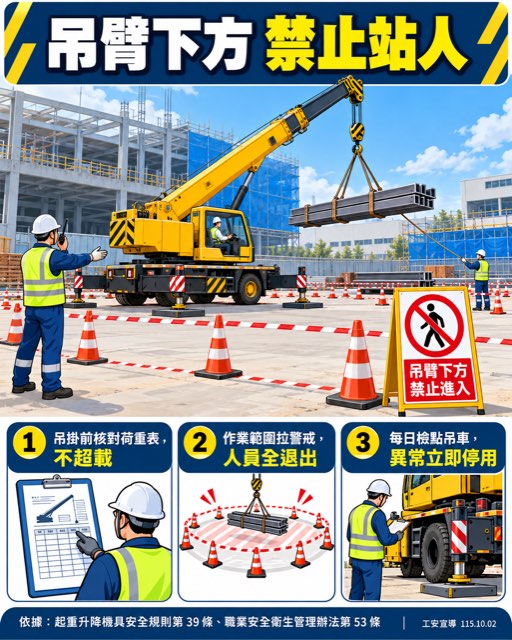
Crane malfunction during lifting operation at SPIL Erlin site construction area, Central Taiwan Science Park Erlin Park, Changhua; 1 person killed on the spot
2026-09-24 · Construction site at Siliconware Precision Industries (SPIL) Erlin site, Central Taiwan Science Park Erlin Park, Erlin Township, Changhua County · 1 dead
On September 24, 2026, an accident occurred during a lifting operation at the construction site of Siliconware Precision Industries' Erlin site in Central Taiwan Science Park Erlin Park, Erlin Township, Changhua County. One person was killed. When firefighters arrived, the victim showed obvious signs of death and was not taken to hospital. Surveillance camera footage circulating online shows a lifting operation under way in the construction area, during which the crane suddenly malfunctioned. According to the report, the cause of the accident, where the deceased was standing at the time, and the full sequence of events linking the lifting operation to the death are still to be clarified by the competent authorities. The report did not state the deceased's identity, whether the deceased worked for a contractor, what load was being lifted or its weight, any action taken by the labor inspection office or the Central Taiwan Science Park Bureau, or any company response. Only one outlet (Lai Media / reporter tip-off site) covered the case, in an exclusive report on October 1. At the time of analysis, no other media had followed up.
Safety poster
Causes (direct / indirect / root)
[Direct] The crane suddenly malfunctioned during the lifting operation (shown in surveillance footage; the report did not state the specific type of malfunction)
[Direct] (inferred) The boom bent or broke, causing the boom or the suspended load to fall and strike a person within the operating area. The report cited an analysis of the footage by a member of the public with engineering experience and said the actual cause would require examining where the boom broke or deformed. However, the report explicitly stated that there is currently no evidence to confirm this
[Indirect] (inferred) A person was under the boom, under the suspended load, or within the crane's operating range, and access to the work area was not controlled
[Indirect] (inferred) Operating conditions were not verified, including overloading, boom extension length or lifting angle exceeding the rated load for that working radius, or side loading (listed in the report as one possible factor; unconfirmed)
[Indirect] (inferred) Boom metal fatigue, welding defects, or earlier damage to the equipment went undetected (listed in the report as one possible factor; unconfirmed)
[Root] (inferred) Before the lifting operation, work conditions were not surveyed and the work method, rigging method and chain of command were not set as required, or they were set but not actually followed on site
[Root] (inferred) The mobile crane's daily pre-operation checks and annual periodic inspections (boom, outriggers, structural damage, overload prevention devices) were not properly carried out or were poorly recorded
[Root] (inferred) Coordination of joint work, hazard communication and site inspections between the principal business entity and contractors for the new plant construction were inadequate (the report did not state the contracting relationships)
Prevention
Before lifting, a legally qualified person should confirm the load's actual weight, center of gravity and working radius, check the load chart, and make sure the lifted load is below the rated load for that working radius. Outriggers should be fully extended, and the ground should be reinforced with pads
Set up a controlled zone around the crane's operating range with fencing or warning tape and assign a signal person. At all times, prohibit anyone from entering the area under the boom, under the suspended load, or within the slewing range of the upper structure. The load's travel path must not pass over people
Before each day's work, check the overwinding prevention device, overload alarm, brakes and controls, and inspect wire ropes, chains and hooks used for rigging. Each year, carry out the required periodic inspection of the boom, outriggers, power transmission devices and structure. If cracks, deformation or welding defects are found, take the crane out of service immediately for repair
Operate the crane only as designed. Do not lift by improper methods such as swinging the boom, side-pulling or dragging loads. The operator must not leave the operating position while a load is suspended
Before work starts, the principal business entity and contractors should prepare a lifting plan and communicate the hazards. Set up a coordination organization on site to carry out regular inspections, and make lifting operations a required topic at every daily toolbox meeting
All workers must wear hard hats and reflective vests. Riggers and signal persons should use radios or clear hand signals so that communication is maintained at all points
Regulations (article numbers verified against Taiwan's law database)
Safety Rules for Cranes and Hoisting Equipment (起重升降機具安全規則) Art. 39: During mobile crane operations, the employer must provide equipment or measures that keep people from entering the area under a suspended load and keep suspended loads from passing over people. The employer must also bar people from the operating range where the upper rotating structure could strike them. In this case, a person was killed while within the operating range when the crane malfunctioned, which suggests that work-area controls may not have been enforced (inferred).
—— During mobile crane operations, the employer shall adopt equipment or measures to prevent persons from entering the area beneath a suspended load and to prevent suspended loads from passing over persons. This does not apply where safety supports or other safety facilities are already in place beneath the suspended load, or the load is otherwise prevented from falling, so that there is no risk of harm to workers.
During mobile crane operations, to prevent collision hazards caused by the rotation of the crane's upper rotating structure, the employer shall prohibit persons from entering the crane's operating range where there is a risk of collision.
Safety Rules for Cranes and Hoisting Equipment Art. 29: Before mobile crane operations, the employer must survey the terrain, ground conditions, work space, weight of the load and crane capacity within the operating range, and then decide the work method, rigging method, travel path and chain of command. The report did not say whether this survey and planning were completed before the lifting operation. This is a key point for the investigation.
—— To prevent hazards such as overturning, caught-in incidents and electric shock during mobile crane operations, the employer shall survey in advance the terrain, ground conditions, work space and weight of the load within the crane's operating range, as well as the type, model and capacity of the crane to be used. The employer shall then determine the following matters and take the necessary measures:
1. The mobile crane's work method, rigging method, travel path, etc.
2. In places with insufficient bearing capacity, such as soft ground, reinforcement measures such as laying steel plates or pads on the ground and using outriggers, to prevent the mobile crane from overturning.
3. The duties of, and chain of command among, the mobile crane operator, riggers, signal persons and other related workers.
For the mobile crane operations in the preceding paragraph, the employer shall take the following measures:
1. After the matters in the preceding paragraph have been determined, inform the relevant workers before work begins and ensure that they comply.
2. Confirm that the type and model of the mobile crane meet the needs of the work.
3. Check how the measures in the preceding paragraph are being carried out. Where safety conditions are not met, no lifting or rigging work may be done until improvements are made.
For the mobile crane operations in paragraph 1, the employer shall do the following:
1. Survey in advance the on-site hazards, limits on conditions of use, work requirements, etc., or require the party commissioning the work to provide this information, and confirm each item using a checklist.
2. Take the necessary preventive or corrective measures based on the results of the hazard survey in the preceding subparagraph.
3. Keep the relevant checklists, vehicle dispatch documents and other records available for inspection until the work is completed.
Safety Rules for Cranes and Hoisting Equipment Art. 63: Workers doing rigging must confirm the crane's rated load and keep the weight of the load below that rated load. They must also estimate the load's weight and center of gravity and check the rigging gear. The report listed overloading and lifting angle as possible causes of the boom bending, and this article sets out the corresponding work requirements.
—— The employer shall ensure that workers who perform rigging with cranes do the following:
1. Confirm the crane's rated load so that the weight of the suspended load is below the rated load.
2. Examine the shape, size, material and other characteristics of the load to estimate its weight, or determine its actual weight, and select suitable rigging gear and use correct rigging methods.
3. Estimate the position of the load's center of gravity to determine the proper point at which to attach the load to the lifting gear.
4. Before lifting, confirm that the strength, specifications and safety factor of the wire ropes, chains and other rigging gear are suitable. Inspect the rigging gear, replace defective items, and store usable and discarded items separately so they are not mixed up.
5. During lifting, secure the load firmly with wire ropes, chains, etc., attach it to the lifting gear, and only then signal the crane operator to begin lifting.
6. Once the load has been lifted off the ground, do not touch it by hand. As soon as the load leaves the ground, signal the crane to pause briefly to check whether the load is tilting, slipping or showing any other problem.
7. Confirm the lifting route, give warnings, and clear any unauthorized persons who have entered the area of the route.
8. Agree on hand signals with the crane operator and guide the crane in raising the load and moving it horizontally.
9. Confirm where the load will be placed and decide how it will be arranged, placed and stacked.
10. Guide the load down to the ground. After confirming that the load is arranged and placed securely, detach the rigging gear from the load.
11. Other matters related to the safety of lifting and rigging operations.
Regulations of Occupational Safety and Health Management (職業安全衛生管理辦法) Art. 20: The employer must inspect a mobile crane every year for damage to the boom, outriggers, power transmission devices and other structural parts, and must inspect its safety devices every month. The report said that determining the cause would require examining where the boom broke or deformed, as well as the equipment's maintenance and periodic inspection records. This article is the legal basis for those periodic inspections.
—— The employer shall carry out a periodic inspection of each mobile crane once a year, covering the following:
1. Whether the boom, outriggers, power transmission devices and other structural items are damaged.
2. Whether the slewing device (including bolts, nuts, etc.) shows any abnormality; displacement and bolt torque shall be measured as specified by the original manufacturer.
3. Whether the overwinding prevention device, alarm devices, brakes, clutches and other safety devices show any abnormality.
4. Whether wire ropes, chains and lifting gear are damaged.
5. Whether wiring, current collectors, switchboards, switches and other mechanical and electrical items show any abnormality.
The employer shall carry out a periodic inspection of the mobile crane in the preceding paragraph once a month, covering the following:
1. Whether the overwinding prevention device, alarm devices, brakes, clutches and other safety devices show any abnormality.
2. Whether wire ropes and chains are damaged.
3. Whether hooks, grabs and other lifting gear are damaged.
4. Whether wiring, current collectors, switchboards, switches and control devices show any abnormality.
Regulations of Occupational Safety and Health Management Art. 53: Before each day's work, the employer must check how the mobile crane's overwinding prevention device, overload alarm, brakes, clutches, controls and similar devices are working. The daily check is the first line of defense for spotting equipment problems and keeping a faulty crane out of service.
—— Before each day's work, the employer shall check the performance of the mobile crane's overwinding prevention device, overload alarm device, brakes, clutches, control devices and other alarm devices.
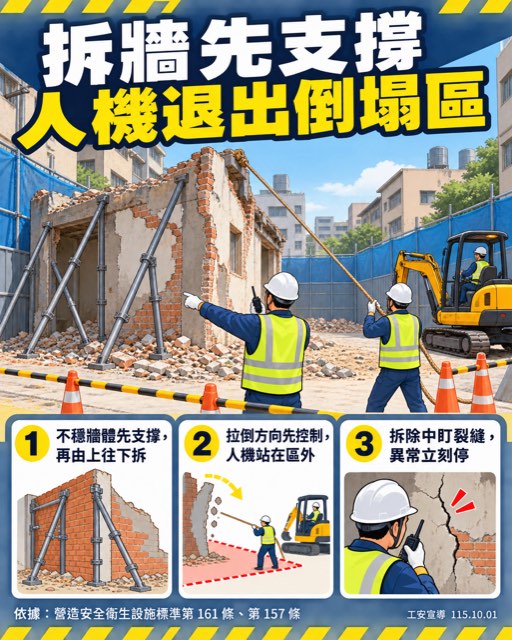
At 4:01 p.m. on 30 September 2026, at a demolition site for an old townhouse on Section 2 of Guiyang Street in Wanhua District, Taipei City, a 58-year-old male worker was operating a mini excavator to demolish the building. A side wall suddenly collapsed in one piece. The falling debris crushed the excavator and trapped the operator inside. Police and firefighters rescued him. He was conscious, but both knees were severely deformed and had open wounds. He was taken to National Taiwan University Hospital for emergency treatment. News reports did not state the number of storeys, the building's age, the contractor, or whether the Labor Affairs Department ordered a work stoppage or imposed a fine. The relevant authorities are investigating the cause of the collapse.
Safety poster
Causes (direct / indirect / root)
[Direct] During demolition, a side wall that had lost its support collapsed in one piece toward the excavator's position.
[Direct] The excavator was operating within reach of the collapsing wall, without enough clearance to retreat and without protection (inferred).
[Indirect] The unstable wall was not shored up first, and its direction of fall was not controlled with ropes or machinery (inferred).
[Indirect] Demolition did not proceed step by step from the top down, or floor slabs and beams were removed first, leaving the side wall without lateral support (inferred).
[Indirect] A mini excavator was used to demolish a cramped old building, and neither the choice of machine nor the work-zone layout suited the structure's characteristics (inferred).
[Root] Before demolition, the stability of each structural member was not checked, and no demolition plan or sequence was drawn up (inferred).
[Root] No designated person directed and supervised the demolition, so the requirement to keep the structure's stability under control at all times was not met (inferred).
Prevention
Before demolition, inspect each member to be demolished one by one. Secure unstable walls first with shoring or guy ropes. Cut off the power supply and utility lines.
Follow the demolition plan and demolish floor by floor from the top down. Lower the wall height before removing lower sections, so a tall wall does not collapse in one piece after losing lateral support.
When demolishing unsupported walls or columns, pull them down to control the direction of fall. Keep operators and machinery outside the collapse zone.
Choose suitable machinery for the structure and the available space. Set up a work zone and keep unauthorized persons out. Where site conditions make this impossible, install catch platforms or switch to manual cutting in sections.
Assign a designated person to direct work on site. During demolition, continuously watch walls for cracks and tilting. If anything abnormal is found, stop work and evacuate immediately.
Machine operators should wear safety helmets and other personal protective equipment. Fit the excavator cab with a falling-object protective structure (FOPS).
Regulations (article numbers verified against Taiwan's law database)
Construction Safety and Health Facilities Standards (營造安全衛生設施標準) Art. 161: Requires walls and columns to be demolished progressively from the top down. Unsupported walls must be suitably shored or controlled to prevent uncontrolled collapse, and workers must stand outside the work zone when structures are pulled down. In this case, the side wall collapsed in one piece onto the machine; it is inferred that it was not shored first and its direction of fall was not controlled.
—— When demolishing walls, columns or other similar structures, the employer shall comply with the following:
1. Demolish progressively from the top down.
2. When demolishing unsupported walls, columns or other similar structures, use suitable shoring or control to prevent uncontrolled collapse.
3. When demolishing by pulling down, have workers stand outside the work zone, and guard against flying fragments.
4. Where a work zone cannot be set up, install catch platforms or scaffolding, or take other suitable precautions.
5. When cutting walls, columns or other similar structures manually, take suitable measures to control dust.
Construction Safety and Health Facilities Standards Art. 157: Requires demolition to proceed in sequence from the top down, with attention paid to controlling the structure's stability at all times during demolition. In this case, the wall collapsed suddenly; it is inferred that stability monitoring and the demolition sequence were deficient.
—— When demolishing structures, the employer shall comply with the following:
1. Workers shall not demolish at different heights at the same time, unless adequate facilities are in place to protect workers below.
2. Demolition shall proceed in sequence, step by step, from the top down.
3. Demolished materials shall not be piled so high that they compromise the stability of floor slabs or structural members, and shall not be stacked against walls.
4. During demolition, attention shall be paid at all times to controlling the stability of the structure being demolished.
5. Demolition shall stop immediately in strong wind, heavy rain or other severe weather that may cause the structure to collapse.
6. Parts of the structure liable to fly off or be shaken loose shall be demolished first.
7. Where dust is raised during demolition, water shall be sprayed as appropriate.
8. When pulling down a structure, suitable steel cables, ropes or other means shall be used, and workers shall withdraw to a safe distance.
9. When demolishing a structure by blasting, facilities to prevent blast-related hazards shall be provided.
10. Underground retaining walls that retain soil and support structures shall not be removed until the structure is properly supported or the earth pressure is supported by sheet piles.
11. Unauthorized persons shall be prohibited from entering the demolition area, and this shall be clearly posted.
Construction Safety and Health Facilities Standards Art. 155: Requires each structural member to be inspected before demolition, and unstable parts to be shored and secured. In this case, demolition of the old building's side wall began without shoring.
—— Before demolishing a structure, the employer shall comply with the following:
1. Inspect each member scheduled for demolition.
2. Shore and secure unstable parts.
3. Cut off the power supply and remove electrical distribution equipment and wiring.
4. Shut off flammable gas pipes, steam pipes, water pipes and other lines. Where flammable gas remains in the pipes, open all doors and windows to release the gas safely.
5. Special safety measures shall be taken for electrical conduits, flammable gas pipes, steam pipes, water pipes and other lines that must remain in service during demolition.
6. Hazardous demolition work zones shall be fenced off or marked, and non-workers shall be prohibited from entering the demolition area.
7. Demolition shall not begin until protective facilities for people using adjacent passageways are completed.
For repair work that requires cutting open or drilling into a structure, the employer shall follow the demolition provisions of the preceding paragraph.
Construction Safety and Health Facilities Standards Art. 159: Requires that when power shovels or similar demolition machines are used, the machinery must be carefully chosen to suit the structure and the available space, a work zone must be set up, and machines must be operated within it. In this case, the mini excavator was working within the collapse range of the old building's wall.
—— When using machinery to demolish structures, the employer shall comply with the following:
1. When using powered shovels, bulldozers or other demolition machinery, choose the machinery carefully to suit the structure, the size of the space and other characteristics.
2. When using a wrecking ball, set up a work zone centered on the point of impact, with a radius of at least 1.5 times the height of the structure. Only operators may enter.
3. When using grapples or articulated-boom machinery, set up a work zone extending at least 8 m beyond the travel path of the grapple or boom. Only operators may enter.
4. Demolition machinery shall be operated within the work zone.
5. When cranes are used to demolish steel structures, their installation and use shall comply with the relevant crane regulations.
6. When scaffolding is used, its stability shall be maintained, and it shall not be placed directly against the structure being demolished.
🔴 FatalStruck byTaiwanConstruction (civil and hydraulic engineering)
Formwork worker resting beside a temporary access road during lunch break run over and killed by a ready-mix concrete truck at a stream remediation project in Taimali, Taitung
2026-09-30 · Temporary access road at the stream remediation project site, Duoliang Village, Taimali Township, Taitung County · 1 dead
At about 1:00 pm on 30 September 2026, at a stream remediation project site in Duoliang Village, Taimali Township, Taitung County, a 58-year-old formwork worker was lying down to rest beside the site's temporary access road after lunch. A ready-mix concrete truck about to enter the work area ran over him. He had no breathing or heartbeat at the scene. Initial police findings: the temporary access road includes an uphill section, and the driver's view was likely blocked by the terrain, creating a blind spot. The driver did not notice the man lying beside the road. The man normally did formwork in Taitung City. He had come south on 29 September to help because the project was behind schedule, so the accident happened on his second day at this site. The project was remediating the stream because local typhoons and heavy rain often cause debris flows, and it was scheduled for completion at the end of October. Police sealed off the scene and reviewed video footage to establish the truck's route and the driver's line of sight. They also asked a prosecutor to examine the body and summoned the people involved for questioning. News reports did not name the contractor or the project owner.
Safety poster
Causes (direct / indirect / root)
[Direct] The worker was lying down to rest beside a temporary access road used by vehicles and machinery, in the ready-mix truck's path and in the driver's blind spot
[Direct] On the uphill section, the ready-mix truck driver did not notice a person on the ground ahead because the terrain blocked his view
[Indirect] The site had no rest area separated from vehicle routes, so workers could lie down beside the access road (inferred)
[Indirect] When the ready-mix truck entered the work area, no traffic controller or banksman directed it or confirmed the route was clear (inferred)
[Indirect] The relief worker, on his second day at the site, had not been told about the site's vehicle routes or restricted areas (inferred)
[Root] Vehicle and machinery routes and work methods were not surveyed and planned in advance or communicated to all workers (inferred)
[Root] While the project was being rushed, workers and vehicles moved in and out at the same time, with no separation of people and vehicles and no rules for the lunch break (inferred)
Prevention
Set up a fixed rest area on site, separated from vehicle routes by fencing or signs. Do not allow workers to lie down and rest on or near access roads, slopes or vehicle entrances
When ready-mix trucks, gravel trucks and other vehicles enter the work area, assign a traffic controller to confirm the route is clear before letting them through. Install convex mirrors at blind spots on slopes and bends
Survey and plan vehicle and machinery routes, work methods and times in advance. Explain them to all workers, including temporary relief workers, before work starts
Give new or relief workers a site hazard briefing on their first day. Clearly explain vehicle routes, no-entry areas and where to rest
Fit vehicles and machinery with reversing and blind-spot alarms and dashcams. During the lunch break, use a public announcement or whistle to warn workers before vehicles move in or out
Require workers to wear high-visibility vests wherever vehicles enter or leave, so drivers can see them more easily
Regulations (article numbers verified against Taiwan's law database)
Construction Safety and Health Facilities Standards (營造安全衛生設施標準) Art. 8-1: Requires the employer to survey the site's terrain, the types of vehicles and machinery, their routes and their work methods in advance, and to inform workers before work begins. Here, the access road had an uphill blind spot and the relief worker was only on his second day at the site, so the routes and restricted areas were (inferred) not planned or communicated.
—— To prevent vehicles and machinery from overturning or causing surface soil to collapse during work, the employer shall survey the following in advance:
1. The weather, geology and terrain of the work site.
2. The types and performance of the vehicles and machinery to be used.
3. The routes of the vehicles and machinery.
4. The work methods of the vehicles and machinery.
If the survey under the preceding paragraph shows a risk of harm to workers, the employer shall put the workplace in order.
The matters in items 3 and 4 of paragraph 1 shall be communicated to workers before work begins.
Occupational Safety and Health Facilities Rules (職業安全衛生設施規則) Art. 116: Item 15 requires a traffic controller where the operation or movement of vehicles or machinery could strike workers. Item 1 requires that a machine not be started until everyone is clear of it. Here, no one guided the ready-mix truck into the work area or confirmed the route was clear.
—— For vehicles and machinery used at workplaces, the employer shall have the driver or other responsible persons carry out the following:
1. Do not start the machine unless all persons are clear of it, except where the driver is in position as required.
2. Vehicle-type construction machinery and forklifts shall not carry workers during operation except in the seats provided.
3. When vehicle-type construction machinery is operating, no one may enter the operating radius or nearby hazardous areas, except a driver in position as required or where other safety measures are taken.
4. Keep away from live conductors to avoid electric shock.
5. Operate within the safety factor, maximum working load and other limits specified by the manufacturer.
6. Do not park on slopes where there is a risk of sliding, unless other equipment or measures are used.
7. Do not park on major traffic routes at night.
8. Do not drive powered excavating machinery with a loaded shovel, grab, bucket or similar attachment.
9. Do not use vehicles or machinery for anything other than their main purpose, unless a device suitable for that use is fitted and poses no risk to workers.
10. Do not let workers ride on pallets or skids carried on forklift forks, or on any other part of a forklift other than the seat.
11. When the driver leaves the driving position, lower the bucket or other work attachment to the ground, shut off the engine, apply the brakes and secure the machine to prevent it from moving.
12. When a forklift driver leaves the driving position, lower the forks to the ground, shut off the engine and apply the brakes.
13. When repairing vehicles or forklifts, or fitting or removing attachments, use safety props, winches or other devices on booms, jibs, lifting platforms and chassis to prevent objects from falling.
14. Make workers who drive sit-down counterbalance or side-loading forklifts wear the seat belt, unless the seat has a guard or other protection that prevents the driver from being crushed if the forklift tips over.
15. Where the operation or movement of vehicles or machinery could strike workers, assign a traffic controller.
Construction Safety and Health Facilities Standards (營造安全衛生設施標準) Art. 11: Requires traffic controllers where vehicles and machinery come and go frequently, separate entrances for people and vehicles, and a clear line of sight for vehicles and machinery entering and leaving. Here, people and vehicles were not separated on the temporary access road and the line of sight was not clear.
—— At entrances to the workplace for people, vehicles and machinery, the employer shall:
1. Survey in advance the depth of buried underground objects and any hazardous substances, and take appropriate protective measures after assessment to prevent danger from vehicles or machinery running over them.
2. Install sliding gates at site entrances for people and vehicles. Keep them closed when not needed for work, and post signs banning unauthorized entry. Where vehicles and machinery come and go so often that the gate must stay open, assign a traffic controller to guide them in and out.
3. Provide separate entrances for people and for vehicles and machinery, unless warning signs are adequate to prevent traffic accidents.
4. Assign control personnel to:
(1) Control people entering and leaving, and admit no one without appropriate protective equipment.
(2) Control and inspect vehicles and machinery entering and leaving, and admit none that do not meet the requirements in their permit documents.
5. Plan parking areas for vehicles and machinery waiting for the checks under item 4(2), so that traffic on roads outside the site is not affected.
6. Keep a clear line of sight for vehicles and machinery entering and leaving.
Occupational Safety and Health Facilities Rules (職業安全衛生設施規則) Art. 280-1: Requires warning signs and high-visibility vests or similar protective clothing for workers at workplaces where vehicles enter or travel. Here, the driver did not notice the worker lying beside the access road. A high-visibility vest would have made him easier to see.
—— Where the employer has workers work at a workplace with vehicles entering or travelling and there is a risk of traffic accidents, the employer shall clearly post warning signs and provide high-visibility vests or other protective clothing, and ensure that workers wear them.
Fire at 69kV extra-high-voltage substation in Tainan Yongkang textile factory; deputy section chief electrocuted, died at scene
2026-09-30 · Substation yard inside a textile factory site, Zhongzheng North Road, Yongkang District, Tainan City · 1 dead
At 4:27 p.m. on 30 September 2026, a fire broke out in the 69kV-to-11.4kV substation yard inside a textile factory in Yongkang District, Tainan City. On receiving the report, the fire bureau dispatched 17 vehicles and 35 personnel. They first laid hose lines, set up a cordon, and asked the power company to cut the power in an emergency. The power company finished de-energizing the extra-high-voltage supply at 6:07 p.m. Firefighters then entered with fire extinguishers and put out the fire at 6:23 p.m. About 40 square meters burned; the burned materials were switchboards and miscellaneous items. While searching the fire scene, firefighters found the company's deputy section chief lying on the ground, suspected to have been electrocuted. He was clearly dead when found and was not taken to hospital. Reports state the equipment where the fire started belonged to the textile company, not the power company. Reports did not say what work the deputy section chief was doing at the time or give his age. The fire investigation unit and the labor inspection center are investigating the exact cause of the fire and occupational safety responsibility.
Safety poster
Causes (direct / indirect / root)
[Direct] The deputy section chief approached or touched live extra-high-voltage/high-voltage substation equipment and received an electric shock (inferred)
[Direct] A switchboard caught fire while the circuit was still energized; power was only cut after the power company arrived
[Indirect] The equipment area of the substation was entered without first de-energizing, testing for voltage, discharging, and short-circuit grounding (inferred)
[Indirect] No supervisor or co-worker was present, so no one noticed promptly after the electric shock (inferred)
[Indirect] Insulating protective equipment was not used, or the minimum approach distance from live parts was not kept, during the work (inferred)
[Root] Reports do not state whether maintenance of power equipment at this high-voltage-or-above premises was done by qualified electrical technicians, or whether there was a de-energized work procedure and a lockout/tagout system (inferred)
[Root] The emergency procedure for abnormal conditions at the extra-high-voltage substation (cut power first, contact the power supplier) was not followed or workers were not trained in it (inferred)
Prevention
For any inspection, repair, or handling of abnormal conditions in a substation, always de-energize first and complete four steps before entering the equipment area: open the circuit and lock out/tag out → discharge → confirm with a voltage detector → short-circuit and ground
Extra-high-voltage premises must employ a senior electrical technician or contract a licensed electrical equipment inspection and maintenance company; unqualified persons must not maintain power equipment
When electrical equipment catches fire, first cut the power and contact the power company, then use non-conductive extinguishing equipment; do not approach to fight the fire while equipment is live
Before de-energized work or live-line work at high voltage or above, inform workers of the work period, work content, and circuit scope, and assign a supervisor to direct the work on site; lone entry is prohibited
Carry out regular thermal imaging scans and insulation tests in the substation, and clear debris from inside switchboards to reduce fire risk
When live work is unavoidable, use live-line tools and insulating protective equipment, and keep the minimum approach distance
Regulations (article numbers verified against Taiwan's law database)
Occupational Safety and Health Facilities Rules (職業安全衛生設施規則) Art. 276: Requires that maintenance of power equipment at premises receiving high voltage or above be done only by qualified electrical technicians; that power be cut and locked/tagged when servicing electrical equipment poses a risk of electric shock; and that non-conductive extinguishing equipment be used for electrical fires. In this case, a switchboard caught fire and a worker was found lying in the substation while it was still energized, so these de-energizing and emergency procedures are inferred to have been lacking.
—— To prevent electrical accidents, employers shall comply with the following:
1. At factories, buildings used by the public, and premises receiving power at high voltage or above, installation and maintenance of power equipment shall not be performed by anyone other than qualified electrical technicians.
2. When power is cut to adjust electrical machinery, the switch shall be locked or tagged and signed immediately after it is opened. Power may be restored only after the person who signed removes the lock or tag, to ensure safety. However, if that person is unable to perform the duty for any reason, the employer shall assign a suitable deputy to handle power restoration, safety control, and communication.
3. Non-workers shall not freely enter power generation rooms, substation rooms, or power-receiving rooms.
4. Overly long objects such as bamboo ladders, iron pipes, or plastic pipes shall not be carried on the shoulder when approaching or passing electrical equipment.
5. Switches shall be opened and closed positively; switches with locking devices shall be locked after operation.
6. Electrical plugs shall be removed by pulling firmly at the plug itself.
7. Switches shall be turned off quickly and positively.
8. Switches shall not be operated with wet hands or a wet operating rod.
9. No one shall operate any equipment outside the scope of their authority.
10. When electrical equipment or circuits catch fire, non-conductive extinguishing equipment shall be used.
11. For installing or removing advertisements, signboards, or other structures, it shall first be confirmed that the work poses no risk of electric shock before work starts.
12. For laying, construction, cleaning, inspection, repair, or adjustment of electrical equipment and lines that may cause electric shock, power shall be cut, and measures such as locking or posting signs shall be taken to prevent others from restoring power by mistake. This does not apply to live-line work and work near live lines that complies with Articles 256 to 263.
Occupational Safety and Health Facilities Rules Art. 254: Requires that, for work after a circuit is opened, the switch be locked or tagged "De-energized work in progress"; that the circuit be discharged, confirmed dead with a voltage detector, and short-circuited and grounded; and that the de-energized area be fenced with blue tape and the live area with red tape as a warning. In this case, it is inferred that the worker approached the equipment without first de-energizing and testing for voltage.
—— When an employer has workers lay, build, inspect, repair, paint, or perform similar work on an opened circuit, its supporting structures, or structures near the circuit, the employer shall, after confirming the circuit is open, take the following measures for that circuit:
1. During the work, the opened switch shall be locked, tagged "Do not energize" or "De-energized work in progress," or watched by an assigned monitor.
2. If the opened circuit contains power cables, power capacitors, or similar items that may leave a hazardous residual charge, it shall be reliably discharged by a safe method.
3. After residual charge is removed by discharging, the opened circuit shall be checked with a voltage detector to confirm it is de-energized. To prevent electric shock from contact with other circuits, induction from other circuits, or backfeed from other power sources, the circuit shall be reliably short-circuited and grounded with short-circuit grounding devices.
4. If the de-energized work area in the preceding item is part of power generation or substation equipment or a switchyard, the de-energized work area shall be fenced with blue tape or netting and marked with a "De-energized Work Area" sign; live parts shall be fenced with red tape or netting and marked with a "Danger – Live Area" sign as a warning.
When power is restored after the work is finished, it shall first be confirmed that the workers involved are not at risk of electric shock, and power shall be restored only after the short-circuit grounding devices, red and blue tape or netting, and signs are removed.
Occupational Safety and Health Facilities Rules Art. 265: Requires that, for de-energized work, live-line work, and work near live lines at high voltage or above, workers be informed of the work period, work content, and circuits involved, and that a supervisor be assigned to direct the work. In this case, no one noticed promptly after the deputy section chief was shocked, so it is inferred that no supervisor was present.
—— For de-energized work, live-line work, and work near live lines at high voltage or above, the employer shall inform the workers of the work period, the work content, the circuit being worked on, and other circuit systems near it, and shall assign a supervisor to direct the work.
Occupational Safety and Health Facilities Rules Art. 264: Requires that extra-high-voltage premises supplied at over 22,800 volts employ a senior electrical technician or contract an inspection and maintenance company to be responsible for electrical safety. This site receives extra-high-voltage power at 69kV, so whether its maintenance arrangements comply needs to be confirmed.
—— Employers at factories with power equipment, buildings used by the public, and premises receiving power at high voltage or above shall, as follows, employ full-time electrical technicians or contract an electrical equipment inspection and maintenance company to be responsible for the electrical safety of general and emergency power equipment within the demarcation point with the utility's supply equipment:
1. Low voltage: Factories or buildings used by the public supplied at 600 volts or below with a contract capacity of 50 kW or more shall employ a junior electrical technician.
2. High voltage: Premises supplied at over 600 volts up to 22,800 volts shall employ an intermediate electrical technician.
3. Extra-high voltage: Premises supplied at over 22,800 volts shall employ a senior electrical technician.
The qualifications of the full-time electrical technicians in the preceding paragraph are governed by the Regulations Governing Electrical Premises and Full-time Electrical Technicians.
Occupational Safety and Health Facilities Rules Art. 274: Requires that electrical technicians cut the power and immediately contact the power supplier in case of an electrical fire or major fault, and wear rubber gloves when operating high-voltage switches with an operating rod. In this case, power was only cut after the power company arrived, so it is inferred that the factory did not first cut the power itself.
—— In addition to requiring electrical technicians or other persons responsible for electricity to comply with relevant electrical laws and regulations, the employer shall require them to observe the following in their work:
1. Inspect and repair electrical equipment regularly; in case of an electrical fire or major electrical fault, cut the power and immediately contact the local power supplier.
2. Make sure joints between wires, straight joints, branch joints, and joints between wires and devices are firmly connected.
3. Cut the power before removing or installing fuses.
4. Wear rubber gloves when operating high-voltage switches with an operating rod.
5. Be familiar with the operating methods and sequences of all electrical equipment within their work area, such as power generation rooms, substation rooms, and power-receiving rooms.
🔴 FatalFalling objectInternationalConstruction (residential construction; employer and industry classification not stated in the report)
Worker in Dong Nai Province, Vietnam, killed when blade flew off cutting machine and struck his neck
2026-09-19 · Dong Nai Province, Vietnam (construction work at the worker's residence) · 1 dead
On 19 September 2026, a worker in Dong Nai Province, Vietnam, was operating a cutting machine while doing construction work at his residence when the entire cutting machine suddenly flew up and its blade struck him in the neck. He pressed on the wound with his hand to stop the bleeding but could not, and died shortly afterward. The report only stated that the incident may have been caused by carelessness while operating the cutting machine. The type of cutting machine, the material being cut, the deceased's identity and age, and any action by police or authorities were not stated in the report.
Safety poster
Causes (direct / indirect / root)
[Direct] The cutting machine went out of control and flew up while running, and the high-speed rotating blade directly struck the operator's neck (fact)
[Direct] The cutting disc jammed or kicked back, causing the tool to escape the operator's grip (inferred)
[Direct] Too much of the blade was exposed, or the guard was not fitted or not adjusted to the correct position, so it could not block the blade and flying debris (inferred)
[Indirect] The tool was held with one hand or not gripped with both hands, and the workpiece was cut without being secured (inferred)
[Indirect] The cutting disc specifications (maximum operating peripheral speed, diameter) may not have matched the tool's rotational speed, or the disc may have had cracks that were not inspected (inferred)
[Indirect] The operator stood in line with the tangent of the blade's rotation and lacked awareness of the need to stay out of the kickback path (inferred)
[Root] The residential/small construction site lacked pre-use equipment inspections and standard operating procedures (inferred)
[Root] The operator had not received safety training in operating handheld cutting tools (inferred)
[Root] There was no supervision on site and no emergency response or first-aid/bleeding-control preparation (inferred)
Prevention
Cutting machines must be fitted with guards that meet specifications, and removing guards is prohibited; before use, confirm the guard angle blocks the blade and debris on the operator's side
Use only cutting discs marked with a maximum operating peripheral speed no lower than the tool's speed; after changing a disc, inspect it for cracks and test-run it under the guard, and also test-run before work each day
Secure the workpiece with clamps or a vise, hold the tool with both hands, keep your body out of line with the tangent of the blade's rotation (the kickback path), and never cut with the side of an abrasive wheel
Establish standard operating procedures for handheld cutting tools and provide training; include tools and cutting discs in routine self-inspections
Wear personal protective equipment during work, such as a face shield, safety goggles, protective gloves and a cut-resistant neck guard, and keep first-aid bleeding-control supplies on site
Regulations (article numbers verified against Taiwan's law database)
Occupational Safety and Health Facilities Rules (職業安全衛生設施規則) Art. 62: Abrasive wheels must have passed a speed test and be marked with a maximum operating peripheral speed; they must not be run above that speed or used on their side; they must be test-run for at least 1 minute before work each day, and after a wheel change must be inspected for cracks and test-run under the guard for at least 3 minutes. If the tool in this case was an abrasive cut-off machine, it is inferred that wheel selection and pre-use test-run inspections were not carried out.
—— Employers shall comply with the following regarding the use of grinding machines:
1. Abrasive wheels shall be those that have passed a speed test and are clearly marked with a maximum operating peripheral speed.
2. Rules shall require that grinding machines not be used above the specified maximum operating peripheral speed.
3. Rules shall require that, unless the abrasive wheel is designed for side use, its side shall not be used.
4. Rules shall require that grinding machines be test-run for at least 1 minute before work begins each day, and that when an abrasive wheel is replaced it shall first be inspected for cracks and test-run under the guard for at least 3 minutes.
The speed test in Item 1 of the preceding paragraph shall be conducted at the maximum operating peripheral speed increased by 50%. Abrasive wheels with a diameter of less than 10 cm may be exempted from the speed test.
Occupational Safety and Health Facilities Rules (職業安全衛生設施規則) Art. 55: Where cutting tools may endanger workers through flying fragments due to severing or their own defects, guards or enclosures shall be installed on the processing machine. In this case, the blade flew off and struck the worker's neck directly, indicating a lack of an effective guard.
—— Where workpieces, cutting tools, dies, etc. may endanger workers through flying fragments during processing due to severing, cutting, forging or their own defects, the employer shall install guards or enclosures on the processing machine. However, for work such as large workpieces, guards or enclosures shall be installed at appropriate locations.
Machinery, Equipment and Apparatus Safety Standards (機械設備器具安全標準) Art. 95: Abrasive wheels on grinding machines shall be fitted with guards meeting the specified performance. If this occurred in Taiwan, a portable cutting machine would be required to have a compliant guard that must not be removed, in order to stop a broken or ejected wheel.
—— Abrasive wheels of grinding machines shall be fitted with guards having the performance specified in Articles 96 to 104. However, this does not apply where safety protective devices are installed in accordance with Annex A of national standard CNS 16089.
Occupational Safety and Health Facilities Rules (職業安全衛生設施規則) Art. 41: Machinery and apparatus such as grinding machines and abrasive wheels shall have a safe construction and comply with the Machinery, Equipment and Apparatus Safety Standards. If this occurred in Taiwan, the employer would not be allowed to provide non-compliant or modified cutting tools for workers to use.
—— Employers shall ensure that the following machinery, equipment or apparatus have a safe construction and shall handle them in accordance with the Machinery, Equipment and Apparatus Safety Standards:
1. Power press and shearing machinery.
2. Hand-fed planers.
3. Circular saws for woodworking.
4. Powered forklifts.
5. Grinding machines.
6. Abrasive wheels.
7. Explosion-proof electrical equipment.
8. Photoelectric safety devices for power press and shearing machinery.
9. Blade contact prevention devices for hand-fed planers.
10. Kickback prevention devices and saw-tooth contact prevention devices for woodworking circular saws.
11. Others designated and announced by the central competent authority.
5 hospitalized after carbon monoxide poisoning during in-pipe work on water main burial project in Fengyuan, Taichung
2026-09-28 · Intersection of Section 5, Fengyuan Blvd. and Shuiyuan Rd., Fengyuan District, Taichung City (Taiwan Water Corporation Fengyuan Blvd. ring water main burial project) · 5 injured
At about 2:40 p.m. on 2026-09-28, on the Fengyuan Blvd. ring water main burial project contracted out by the Central Region Engineering Office of Taiwan Water Corporation, contractor workers were working inside a water transmission pipe about 60 cm in diameter, roughly 8 m underground. Media reports said they were suspected to be welding the pipeline. One worker became unwell first. Co-workers did not report the incident right away and instead went down themselves to rescue him. About 1 hour later, several of those who had entered also felt dizzy and unwell, and only then was the fire department notified. Special search and rescue personnel wearing self-contained breathing apparatus entered the pipe and hoisted the workers out with ropes. In total, 5 people were taken to hospital (2 Taiwanese nationals and 3 Vietnamese migrant workers). One migrant worker was at one point reported as showing no vital signs, and one person suffered second-degree burns to the back. After hyperbaric oxygen therapy, all were out of danger. Carbon monoxide concentration at the scene was measured at 122 ppm by the Labor Affairs Bureau and 150 ppm by the fire department. The Taichung City Labor Affairs Bureau determined that the business entity had let workers enter without ventilation, air exchange or gas testing. It ordered work to stop, and a fine of NT$50,000 to NT$3,000,000 may be imposed by law. (Some early reports said workers had 'fallen 20 m'. Later reports corrected this to poisoning inside the pipe at a depth of about 8 m.)
Causes (direct / indirect / root)
[Direct] Carbon monoxide built up to 122–150 ppm inside the water transmission pipe (a confined space), and the workers inhaled it and were poisoned.
[Direct] Co-workers entered to attempt a rescue without respiratory protective equipment, which increased the number of victims.
[Indirect] Before entry, there was no ventilation or air exchange, and oxygen and hazardous gas concentrations were not measured (as determined by the Labor Affairs Bureau).
[Indirect] Welding and other in-pipe work produced carbon monoxide, and there was no continuous gas monitoring or forced exhaust (inferred).
[Indirect] Emergency rescue equipment, such as self-contained breathing apparatus and mechanical hoisting devices, was not ready on site, and the incident was reported only about 1 hour after it began (inferred).
[Root] A confined space hazard prevention plan and an entry permit system were not established or not implemented (inferred).
[Root] The contractor's workers, including migrant workers, had insufficient training on confined space hazards and rescue (inferred).
[Root] The project owner did not adequately supervise the contractor's confined space work or manage it through a coordination organization (inferred).
Prevention
Provide forced supply and exhaust ventilation for the entire duration of in-pipe work and confirm it runs effectively and continuously. Use local exhaust close to welding points.
Before entry, have a designated person measure concentrations of oxygen, carbon monoxide, hydrogen sulfide and other gases. During work, monitor continuously with portable multi-gas detectors, and evacuate immediately if limits are exceeded.
Implement an entry permit system: the on-site work supervisor signs the permit, entrants are checked in by roll call at the entrance, and a dedicated attendant stays outside and monitors the work at all times.
Keep self-contained breathing apparatus, a tripod and mechanical hoisting rescue equipment ready at the entrance. Workers entering the pipe must wear full-body harnesses attached to lifelines.
Strictly prohibit going in to rescue someone without respiratory protection. In an emergency, call 119 first and leave the rescue to trained rescue personnel.
Train contractor workers and migrant workers in their native languages on confined space hazards and emergency response. The project owner must carry out contractor management audits.
Regulations (article numbers verified against Taiwan's law database)
Occupational Safety and Health Facilities Rules (職業安全衛生設施規則) Art. 29-4: Before confined space work, oxygen and hazardous substance concentrations must be confirmed, and confirmation must continue throughout the work. In this case, the Labor Affairs Bureau determined that workers were allowed to enter without testing.
—— Where an employer has workers perform confined space work in which oxygen-deficient air or hazardous substances may endanger them, the employer shall provide measuring instruments, confirm oxygen and hazardous substance concentrations before the work begins, and take measures for continuous confirmation during the work.
Occupational Safety and Health Facilities Rules Art. 29-5: Suitable ventilation equipment must be installed and confirmed to run effectively and continuously. In this case, the lack of ventilation allowed carbon monoxide to build up to 122–150 ppm.
—— Where an employer has workers perform work in a confined space that may endanger them, the employer shall install suitable ventilation and air exchange equipment, and confirm that it keeps running effectively and continuously and that the workplace has no oxygen deficiency, hazardous substances or other conditions that would endanger workers.
The confirmations required by the preceding article and the preceding paragraph shall be carried out by a designated person, and records shall be kept for three years.
Occupational Safety and Health Facilities Rules Art. 29-6: Entry into a confined space requires a signed permit and roll-call check-in, and the permit must record test results and protective equipment. In this case, there was no evidence that a permit system was implemented (inferred).
—— Where an employer has workers perform work in a confined space that may endanger them, the entry permit shall be signed by the employer, the person in charge of the workplace or the on-site work supervisor before workers may enter. Workers' entry and exit shall be confirmed and checked by roll call, and records shall be kept for three years.
The entry permit referred to in the preceding paragraph shall state the following:
1. The workplace.
2. The type of work.
3. The work time and duration.
4. The measured oxygen and hazardous substance concentrations at the workplace, with the signature of the person who took the measurements.
5. Possible hazards at the workplace.
6. Energy or hazard isolation measures at the workplace.
7. Equipment and methods for communication between workers and the outside.
8. Protective equipment and rescue equipment prepared, and how to use them.
9. Other safety measures to protect workers.
10. Persons permitted to enter, with their signatures.
11. On-site attendants, with their signatures.
Where an employer has workers enter a confined space to perform hot work such as welding, cutting, burning or heating, in addition to complying with paragraph 1, the employer shall designate a person to confirm that there is no risk of hazard. The employer, the person in charge of the workplace or the on-site work supervisor shall confirm safety and sign a hot work permit before the work may begin.
Occupational Safety and Health Facilities Rules Art. 29-7: In confined spaces where poisoning may occur, workers must wear full-body harnesses, and mechanically assisted hoisting rescue equipment must be provided. In this case, co-workers attempted the rescue themselves for about 1 hour without success.
—— Where an employer has workers perform confined space work that may cause oxygen deficiency or poisoning, the employer shall comply with the following:
1. Where the work area is beyond the attendant's line of sight, workers shall wear a full-body harness meeting CNS14253-1 or an equivalent or higher standard, together with a device that can detect the worker's movement.
2. Emergency rescue equipment with powered or mechanically assisted hoisting shall be provided. This does not apply where installing such equipment on site is genuinely difficult and other suitable emergency rescue arrangements are in place.
3. For oxygen-deficiency hazardous work listed in the Oxygen Deficiency Prevention Rules (缺氧症預防規則), an oxygen-deficiency work supervisor shall be designated, and the relevant provisions of those Rules shall be followed.
Drilling Rig Collapses at Miami Construction Site, Crushing Vehicles and Injuring 4
2026-09-14 · Construction site near Brickell Bay Drive and SE 12th Street, Brickell district, Miami, Florida, USA · 4 injured
At around 8 a.m. local time on Monday, 2026-09-14, a drilling rig about 85 feet (about 26 m) tall (mostly called a "crane" in Chinese-language reports) at a new high-rise construction site in Miami's Brickell district toppled onto Brickell Bay Drive. It crushed 3 vehicles and 1 site container, and one SUV caught fire. Two workers inside the container (aged 27 and 29) were trapped in twisted steel and were freed by a technical rescue team using hydraulic rescue tools. They, the 47-year-old equipment operator and 1 driver, 4 people in total, were taken to hospital. All were reported to have minor injuries and to be in stable condition. Another 18 workers at the site were safely evacuated, and about 50 firefighters responded. Reports did not state the cause of the collapse. The US Occupational Safety and Health Administration (OSHA) has opened an investigation.
Safety poster
Causes (direct / indirect / root)
[Direct] The drilling rig, about 26 m tall, lost stability and collapsed, with the machine body falling onto the road and the container (collapse mechanism not stated in reports)
[Indirect] Insufficient ground bearing capacity at the rig's setup location, or failure to lay mats or pour concrete and take other anti-tipping measures (inferred)
[Indirect] Inadequate inspection of rig assembly, mast securing, or working load (inferred)
[Indirect] The rig's collapse zone covered a public road and a site container, and no adequate hazard-zone control was established (inferred)
[Root] For foundation-equipment work next to urban roads, the construction plan did not adequately assess the collapse zone and risk to the public (inferred)
[Root] The daily pre-operation inspection and supervision system for the equipment was not properly implemented (inferred)
Prevention
Before setting up the equipment, confirm the ground bearing capacity. On soft ground, lay steel plates or mats or pour concrete, and improve the ground if needed
After assembly, inspect each item: components, connections, wire ropes, brakes and footing stability. Allow operation only after everything passes
Mark a collapse hazard zone with a radius equal to the equipment's full height. Do not place worker rest areas or containers inside it, and apply traffic control on adjacent roads
Stop work and lower the mast during strong winds or when ground conditions are abnormal
Operators must be certified and must not leave the controls while a load is applied. Assign a signal person and a watch person
Regulations (article numbers verified against Taiwan's law database)
Construction Safety and Health Facilities Standards (營造安全衛生設施標準) Art. 109: If in Taiwan, the employer must prevent the collapse of powered piling and similar construction equipment. On soft ground, mats or base plates must be laid or concrete poured, and the footing must be secured. In this case, the entire rig collapsed.
—— To prevent the collapse of powered piling and similar construction equipment, the employer shall comply with the following:
1. When installed on soft ground, lay mats or base plates, pour concrete, or take similar measures.
2. When installing equipment, confirm its durability and strength; if insufficient, reinforce it immediately.
3. Where the legs or frame are at risk of sliding, secure them with stakes, chains, or similar means.
4. Where moved on rails or rollers, secure with rail clamps or similar means to prevent sudden movement.
5. Where the top of the equipment is secured with stays or guy ropes, there shall be at least three, with their ends secured and spaced at equal intervals.
6. Where secured by counterweight balancing, the counterweight shall be firmly fixed to the leg frame to prevent it from moving.
Construction Safety and Health Facilities Standards Art. 126: If in Taiwan, when assembling piling and similar construction equipment, each item must be checked: components, connections, wire ropes, brakes and footing stability, to prevent collapse.
—— When assembling piling and similar construction equipment, the employer shall confirm each of the following:
1. Components show no abnormalities before assembly.
2. Connected parts of the machine body are not loose or damaged.
3. Hoisting wire ropes, sheaves and pulley devices are properly installed.
4. The brake system of the hoisting device performs well.
5. The winch is properly installed.
6. Guy lines are properly arranged and secured.
7. The footing is stable to prevent collapse.
Construction Safety and Health Facilities Standards Art. 108: If in Taiwan, the machine body and attachments of piling and similar construction equipment must have the necessary strength and be free of significant damage or deformation. The cause of collapse is still under investigation and should be included in the inspection.
—— For pile or foundation pile construction equipment used for pile driving, pile extraction and similar work by powered impact, vibration, pre-drilling or similar methods (hereinafter "piling and similar construction equipment"), the employer shall ensure that the machine body and its attachments and parts have the strength necessary for their intended use, and are free of significant damage, wear, deformation or corrosion.
Occupational Safety and Health Facilities Rules (職業安全衛生設施規則) Art. 116: If in Taiwan, while vehicle-type construction machinery is operating, people must be kept out of the operating radius and any nearby hazardous area. In this case, workers were trapped in a container within the rig's collapse zone.
—— For vehicle machinery operating at a workplace, the employer shall have the operator or relevant personnel carry out the following:
1. Do not start the machine unless all persons are clear of it, except when the operator is in position as required.
2. Vehicle-type construction machinery and forklifts shall not carry workers during operation except in the seats provided.
3. While vehicle-type construction machinery is operating, prohibit persons from entering the operating radius or nearby places where there is a risk of danger, except when the operator is in position as required or other safety measures are taken.
4. Keep clear of live conductors to avoid electric shock.
5. Operate according to the safety factor, maximum working load and other specifications set by the manufacturer.
6. Do not park on slopes where there is a risk of sliding, unless other equipment or measures are in place.
7. Do not park on main traffic routes at night.
8. Do not drive powered excavating machinery while its shovel, grab, bucket or similar is loaded.
9. Do not use vehicle machinery for purposes other than its main use, unless a device suited to that use is fitted and there is no risk of harm to workers.
10. Do not let workers ride on pallets or skids carried on forklift forks, or on any other part of the forklift other than the seat.
11. When the operator leaves the operating position, lower the bucket or other working device to the ground, shut off the engine, apply the brakes and take similar measures to prevent the machine from running away.
12. When a forklift operator leaves the operating position, lower the forks to the ground and shut off and brake the engine.
13. When repairing vehicles or forklifts, or installing or removing attachments, use safety props, winches or similar devices on booms, outriggers, lifting platforms and chassis to prevent objects from falling.
14. For seated counterbalance forklifts and side-loading forklifts, ensure the worker driving uses the seat belt, unless the seat is fitted with guards or other protection that prevents the driver from being crushed if the forklift tips over.
15. Where operation or movement of vehicle machinery may strike workers, assign a traffic control and guide person.
Basement fire at urban-renewal construction site on Leye Street, Da'an District, Taipei burns for nearly 20 hours; firefighter suffers heat exhaustion while cooling down residual fire, is intubated and admitted to ICU
2026-09-27 · Basement of an urban-renewal new-building construction site on Leye Street (opposite No. 87), Da'an District, Taipei City · 1 seriously injured (firefighter with heat exhaustion, intubated and admitted to ICU); 2 other crew members felt unwell, were treated and are fine; no worker casualties at the site
At 9:09 p.m. on 26 September, a fire broke out in the basement of an urban-renewal new-building construction site on Leye Street, Da'an District, Taipei City, run by the National Housing and Urban Regeneration Center (reports differ on whether it was the 3rd or 4th basement level). Large amounts of building materials and formwork were stored in the basement; the space was narrow and heat could not escape, so the fire smouldered. The Fire Department deployed 102 personnel and 30 fire engines, and the fire was put out at 4:40 p.m. on the 27th. About 3,000 square metres burned; no one at the site was trapped, injured or killed. At about 5:43 p.m. on the 27th, a firefighter from the Anhe Squad suddenly felt unwell while cooling down the scene and handling residual fire. He had a body temperature of 41 degrees, a pulse of 165 beats per minute and blood pressure of 86/59, and was agitated and confused. He was taken to Taipei Medical University Hospital, given sedatives and intubated, and moved to the intensive care unit at about 8 p.m. Two other crew members at the scene also felt unwell; they were treated and are fine. The Construction Management Office found that the site had no fire-prevention measures. Under the Building Act, it fined the contractor and the supervising firm NT$90,000 each and ordered work to stop. To resume work, they must submit a safety assessment report and an improvement plan. The cause of the fire was not stated in reports and is still under investigation.
Causes (direct / indirect / root)
[Direct] The firefighter wore heavy rescue gear and worked for a long time cooling the scene and handling residual fire in a hot, smoky basement fire zone; body heat built up and caused heat exhaustion (body temperature 41 degrees)
[Direct] Large amounts of combustible materials, such as building materials and formwork, were stored in the basement; once ignited, they smouldered in the enclosed space for nearly 20 hours
[Indirect] The fire lasted nearly 20 hours; rotation, rest and cooling time for rescue personnel may have been insufficient (inferred)
[Indirect] The site had no fire-prevention measures (as found by the Construction Management Office), so the fire could not be put out in its early stage (inferred)
[Root] The site lacked management of the storage and separation of combustible building materials in the basement, and of fire-fighting equipment
[Root] Long-duration firefighting lacked a rotation, physiological monitoring and recovery (rehab) system centred on heat hazards (inferred)
Prevention
Store combustible building materials and formwork in the basement in separate zones away from ignition sources, limit the amount stored, and clear combustible waste at the end of every workday
Provide enough fire extinguishers and fire-fighting equipment in storage areas and basement levels, post no-smoking/no-open-flame signs, and keep materials from blocking extinguishers and passageways
Enforce permits for hot work and fire-watch patrols after work ends (at least 30 minutes of monitoring)
Set mandatory rotation times for long-duration high-heat work, provide a shaded cooling rest area, and supply drinking water and electrolytes
Check body temperature and heart rate at regular intervals during work; if agitation or a change in consciousness appears, stop work immediately and start emergency transport to hospital
Site contractors, supervising firms and partner rescue units should run fire-response and evacuation drills in advance
Regulations (article numbers verified against Taiwan's law database)
Occupational Safety and Health Facilities Rules (職業安全衛生設施規則) Art. 324-6: Requires cooling, shaded rest areas, drinks, adjusted work hours, patrols and emergency medical arrangements to prevent heat illness. In this case, heat exhaustion occurred after long-duration high-heat work at the fire scene, showing that heat-hazard prevention and rotation were insufficient (if treated like high-heat work by ordinary workers).
—— When an employer has workers perform outdoor work, to prevent heat illness caused by the environment, the employer shall take the following hazard-prevention measures according to weather conditions:
1. Lower the temperature of the workplace.
2. Provide a shaded rest area.
3. Provide suitable drinks or salt water.
4. Adjust working hours.
5. Increase the frequency of workplace patrols.
6. Carry out health management and assign work appropriately.
7. Take measures for workers' heat acclimatization.
8. Pay attention to workers' health before and during work.
9. Provide education and awareness on preventing heat illness.
10. Set up emergency medical, reporting and response mechanisms.
Construction Safety and Health Facilities Standards (營造安全衛生設施標準) Art. 12: Flammable materials stored at a workplace must be stored separately, with no-smoking/no-open-flame signs and suitable fire extinguishers. Large amounts of formwork and building materials in the basement caught fire and smouldered, and fire-prevention measures were found to be missing.
—— Where flammable materials are stored at a workplace, the employer shall provide a cover to prevent direct sunlight, and shall store them separately, post no-smoking/no-open-flame warning signs, and provide suitable fire-extinguishing equipment.
Construction Safety and Health Facilities Standards Art. 29: Construction materials must be stored in an orderly way, and warehouses must have warning signs, barriers and fire-fighting equipment. Building materials piled in the basement lacked fire-fighting equipment, allowing the fire to spread.
—— The employer shall ensure that all kinds of construction materials are stored, stacked and arranged in an orderly way, and shall not store them within 2 metres of a warehouse door or elevator, or anywhere that obstructs traffic. Warehouses shall have the necessary warning signs, barriers and fire-fighting equipment.
Construction Safety and Health Facilities Standards Art. 31: Material storage must not block the use of emergency equipment such as fire alarms, fire extinguishers and passageways. A basement full of building materials hindered early firefighting and rescue routes.
—— The employer shall plan the storage of all kinds of materials properly, and storage shall not obstruct the use of emergency equipment such as fire alarms, fire extinguishers, first-aid equipment, passageways, electrical switches and fuse boxes.
🟠 Serious / multiple injuriesFall from heightTaiwanConstruction
Two workers injured after falling from 14th-floor scaffolding to 13th floor at building under construction in Xinshi, Tainan
2026-09-25 · Building under construction at the intersection of Guanghua Street and Nangang Street, Xinshi District, Tainan City · 2 injured
At around 12 noon on 25 September 2026 (the first day of the Mid-Autumn Festival long weekend), two male workers, aged 59 and 72, were doing scaffolding work on the 14th floor of a building under construction at the intersection of Guanghua Street and Nangang Street in Xinshi District, Tainan City. They apparently lost their footing and fell from the 14th floor onto a 13th-floor platform, a drop of about 3 m. When firefighters arrived, both men were conscious. The 59-year-old had pain in both legs. The 72-year-old had a minor laceration on his right ear and abrasions on his hands and feet. Both were taken to Tainan Municipal An-Nan Hospital for treatment, and neither injury was life-threatening. The labour inspection authority was notified and sent inspectors to the site. Whether there were occupational safety failures is still under investigation. Reports did not state the specific work being done, the fall protection in place, or whether safety harnesses were used. They also did not state whether a stop-work order was issued.
Causes (direct / indirect / root)
[Direct] While working on 14th-floor scaffolding, the workers lost their footing and fell about 3 m onto the 13th-floor platform
[Direct] (inferred) Fall protection at the work position, such as guardrails, platform boards or safety nets, was inadequate or had gaps and did not stop the fall
[Direct] (inferred) The workers were not properly wearing safety harnesses attached to a lifeline or a secure anchorage
[Indirect] (inferred) The scaffold platform boards were not laid fully and tightly together or were not tied down, so a worker stepped into a gap or a board shifted
[Indirect] (inferred) Work was being rushed during the long weekend, so on-site supervision and pre-work inspections may have been lax
[Indirect] (inferred) The workers were older (aged 59 and 72), with reduced balance and reaction ability, and this was not considered in work assignment
[Root] (inferred) No fall prevention plan was drawn up and carried out based on the risks of working at height
[Root] (inferred) Weekly scaffold inspections and pre-work checks were not properly carried out
[Root] (inferred) There was no system for assigning suitable tasks to older workers or for supervising their safety
Prevention
Install guardrails along the edges of every scaffold working platform level and hang safety nets. Close all openings and gaps before work starts. Where these cannot be installed, use other fall protection measures.
Working platforms must be at least 40 cm wide, with platform boards laid fully and tightly together and tied down. Gaps between boards must not exceed 3 cm.
Install lifelines or anchorages. All work at height must be done wearing a full-body harness that is properly clipped on, and the site supervisor must check each worker individually.
Carry out the required weekly scaffold inspection, and check guardrails, platform boards and wall ties before work starts each day. No one may go up the scaffold until defects are fixed.
Assign extra supervisors during long weekends and rush periods. Give older workers priority for tasks that are not at height, and check their health and alertness more closely before work.
Regulations (article numbers verified against Taiwan's law database)
Construction Safety and Health Facilities Standards (營造安全衛生設施標準) Art. 17: Where work at a height of 2 m or more involves a fall risk, a fall prevention plan must be prepared, and fall protection must be applied in priority order, including guardrails, safety nets and safety harnesses. In this case a fall still occurred during work on 14th-floor scaffolding, which shows that fall protection planning was inadequate.
—— For workplaces at a height of 2 metres or more where workers are at risk of falling, the employer shall prepare a fall prevention plan, plan according to the following order of risk control priority, and adopt appropriate fall prevention measures:
1. Through the choice of design or construction method, have workers complete work on the ground as far as possible, reducing the number of tasks performed at height.
2. Through changes to the construction sequence, give priority to installing the permanent structure's access equipment or fall protection facilities.
3. Install guardrails and covers.
4. Hang safety nets.
5. Set up a warning line system.
6. Restrict worker entry into controlled areas.
7. Have workers wear safety harnesses.
8. For open edges, formwork, finishing work and similar operations, and where adopting the measures in subparagraphs 1 to 4 would increase the hazard of the work, a protection plan shall be prepared and implemented.
Construction Safety and Health Facilities Standards Art. 48: For scaffold work at 2 m or more, a working platform of adequate strength must be provided. It must be at least 40 cm wide, with platform boards laid fully and tightly together and tied down. A worker lost his footing on the scaffold, so it is inferred that the working platform was deficient.
—— When an employer has workers work on scaffolding at a height of 2 metres or more, the following shall apply:
1. A working platform of adequate strength shall be provided.
2. The working platform shall be at least 40 centimetres wide and fully covered with tightly fitted platform boards. It shall have at least two support points and shall be tied and secured so that it cannot come loose or shift. Gaps between platform boards shall not exceed 3 centimetres.
3. Where movable platform boards are made of timber, they shall be at least 20 centimetres wide, at least 3.5 centimetres thick and at least 3.6 metres long. Where the width exceeds 30 centimetres, the thickness shall be at least 6 centimetres and the length at least 4 metres. They shall have at least three support points. The board ends shall project at least 10 centimetres beyond the support points, but not more than one-eighteenth of the board length. Where boards overlap lengthwise, the overlap shall be at a support point, and the overlapping length shall be at least 20 centimetres.
4. The working platform shall be at least 1 metre below the top of the scaffold standards.
The board length requirement in subparagraph 3 of the preceding paragraph does not apply in confined spaces.
Construction Safety and Health Facilities Standards Art. 19: Where working platforms and similar locations at 2 m or more present a fall hazard, guardrails, covers or safety nets must be installed. Where installation is difficult, workers must use safety harnesses. In this case the protective equipment did not stop the fall.
—— For work at roofs, steel beams, openings, steps, stairs, ramps, working platforms, retaining walls, earth-retaining supports, construction platforms, bridge piers and columns, bridge superstructures, abutments and similar locations at a height of 2 metres or more, where workers are at risk of falling, the employer shall install guardrails, covers, safety nets or other protective equipment at those locations.
Where it is difficult for the employer to install the equipment in the preceding paragraph, or where guardrails, covers, safety nets or other protective equipment are temporarily opened or removed as required by the work, measures such as having workers use safety harnesses shall be taken to prevent falls. However, once the reason for the difficulty no longer exists, the preceding paragraph shall apply.
Occupational Safety and Health Facilities Rules (職業安全衛生設施規則) Art. 281: For work at a height of 2 m or more, workers must properly use safety harnesses, safety helmets and other protective equipment. Reports did not state whether the workers wore safety harnesses, so how well this was enforced needs to be reviewed.
—— For work at a height of 2 metres or more where workers are at risk of falling, the employer shall have workers properly use safety harnesses, safety helmets and other necessary protective equipment, unless the employer has adopted measures such as safety nets.
The safety harnesses in the preceding paragraph shall be of a suitable type selected according to national standards based on the characteristics of the work. For movement at height or on inclined surfaces, such as on steel cantilever projections, sloped hoardings, vertical fixed ladders over 2 metres without cages or other protective devices, confined spaces, roofs, scaffold erection and dismantling, working platform erection and dismantling, and pipeline maintenance, a full-body harness and a self-retracting fall arrester meeting national standard CNS 14253-1 or an equivalent or higher standard shall be used.
Occupational Safety and Health Management Regulations (職業安全衛生管理辦法) Art. 43: Scaffolds must be inspected weekly for the condition of scaffold members, the fixing of foot beams and whether guardrails have come off. The incident suggests that scaffold condition may not have been properly managed.
—— The employer shall inspect scaffolding and construction platforms for the following items once every week:
1. Damage to and installation condition of scaffold members.
2. Looseness of fixed, contact and installed parts of standards, ledgers, foot beams and similar components.
3. Damage to and corrosion of fixing materials and metal fittings.
4. Removal or detachment of handrails, guardrails and similar components.
5. Settlement and sliding of base plates.
6. Condition of bracing, ties, ledgers and other reinforcing members.
7. Damage to standards, foot beams, ledgers and similar components.
8. Installation of cantilever beams and suspension ropes, and performance of suspension and stopping devices.
9. Spacing of wall ties and condition of connecting members.
The inspection in the preceding paragraph shall also be carried out after strong winds, heavy rain or other severe weather, after an earthquake of intensity 4 or above, and before work resumes after every work stoppage.
Worker dies after falling from 4 m height at Zhubei apartment building construction site
2026-08-17 · Apartment building construction site, Guangming 6th Road, Zhubei City, Hsinchu County · 1 dead
At 4:24 p.m. on 17 August 2026, the fire department received a report that a worker had apparently fallen from a height of about 4 m at a new apartment building construction site in Zhubei City, Hsinchu County. Formosa TV (民視) reported his age as 45, while Nextapple (壹蘋) reported about 50. He had no breathing or heartbeat (OHCA) when taken to hospital and died despite resuscitation efforts. At the time, the site was carrying out exterior, mechanical and electrical (M&E), and interior fit-out work. The reports did not state where he fell from (an opening, scaffolding, or a floor edge) or what task he was doing. Citing the site's lack of adequate safety protection equipment, the Hsinchu County Government fined the contractor and the developer NT$18,000 each. It ordered work on that task to stop immediately and required a report on corrective measures within one week. The developer expressed regret and said the cause was still being clarified with the contractor. This incident occurred in August; it reappeared in news sources on 24 September when it was republished by LINE TODAY.
Safety poster
Causes (direct / indirect / root)
[Direct] The worker fell while working at a height of about 4 m (as reported)
[Direct] The fall location lacked adequate safety protection equipment (the county government's stated reason for the penalty)
[Indirect] Openings or edges had no guardrails, covers or safety nets, or these were temporarily removed for work and not reinstated (inferred)
[Indirect] The worker did not use a safety harness, or there was no lifeline or anchor point on site to attach to (inferred)
[Root] The fall prevention plan was not updated for the fit-out and finishing stage, and control of work at height had slackened (inferred)
[Root] The developer did not adequately supervise the contractor's safety; this project has had several collapses in the past, pointing to systemic problems in on-site safety management (inferred)
Prevention
Install guardrails or covers at all openings and floor edges 2 m or higher; if they must be removed for work, reinstate them immediately after the work is finished
During the fit-out and M&E finishing stage, re-identify all fall hazards and update the fall prevention plan following the hierarchy of risk controls
Where guardrails cannot be installed, hang safety nets or install lifelines, and require full-body harnesses to be properly attached
Before work starts each day, have a designated person inspect guardrails and covers for completeness; no work may proceed until deficiencies are corrected
The developer should check each contractor's work-at-height arrangements on entry to the site and conduct unannounced audits; violators must stop work until corrections are made
Regulations (article numbers verified against Taiwan's law database)
Construction Safety and Health Facilities Standards (營造安全衛生設施標準) Art. 19: Openings, work platforms and similar locations 2 m or higher must have guardrails, covers or safety nets; where installation is difficult or they are temporarily removed, workers must use safety harnesses. In this case, the 4 m high location lacked adequate protection equipment.
—— Where workers are at risk of falling while working at roofs, steel beams, openings, steps, stairs, ramps, work platforms, retaining walls, earth-retaining supports, construction platforms, bridge piers and columns, bridge superstructures, abutments and similar locations 2 m or more in height, the employer shall install guardrails, covers, safety nets or other protective equipment at those locations.
Where it is difficult for the employer to install the equipment in the preceding paragraph, or where guardrails, covers, safety nets or other protective equipment are temporarily opened or removed for work purposes, the employer shall take fall prevention measures such as having workers use safety harnesses. However, once the reason for the difficulty no longer exists, the preceding paragraph shall apply.
Construction Safety and Health Facilities Standards Art. 17: For work at 2 m or higher, a fall prevention plan must be drawn up and fall protection measures taken according to the hierarchy of risk controls; the finishing stage requires specific planning. Implementation of the fall prevention plan in this case should be reviewed.
—— For workplaces 2 m or more in height where workers are at risk of falling, the employer shall draw up a fall prevention plan, plan according to the following order of risk controls, and adopt appropriate fall prevention measures:
1. Through choice of design or construction method, have workers complete work on the ground as far as possible, reducing work at height.
2. Through changes to the construction sequence, give priority to building the permanent structure's access equipment or fall protection.
3. Install guardrails and covers.
4. Hang safety nets.
5. Install warning line systems.
6. Restrict worker entry to controlled areas.
7. Have workers wear safety harnesses.
8. Where open edges, formwork, finishing work and the like, or the measures in items 1 to 4, increase the hazards of the work, a protection plan shall be drawn up and implemented.
Occupational Safety and Health Facilities Rules (職業安全衛生設施規則) Art. 281: For work at heights of 2 m or more, workers must properly use safety harnesses, safety helmets and other protective equipment. The reports did not state whether such equipment was provided and properly used in this case; this should also be examined.
—— For work at heights of 2 m or more where workers are at risk of falling, the employer shall have workers properly use safety harnesses, safety helmets and other necessary protective equipment, unless the employer has adopted safety nets or similar measures.
The safety harnesses in the preceding paragraph shall be of an appropriate type selected according to national standards, based on the nature of the work. For movement at height or on inclined surfaces, such as steel cantilever projections, sloped hoardings, vertical fixed ladders 2 m or higher without cages or similar protection, confined spaces, roofs, scaffold erection and dismantling, work platform erection and dismantling, and pipeline maintenance, full-body harnesses and retractable fall arresters meeting CNS 14253-1 or an equivalent or higher standard shall be used.
🔴 FatalCollapseTaiwanConstruction (mechanical and electrical works contractor)
Electrical panel slides and tips over during moving at Hsinchu Science Park Baoshan wafer fab construction site; 22-year-old contractor worker crushed to death
2026-08-17 · Wafer fab (F20) new construction site, Hsinchu Science Park Baoshan Park, Baoshan Township, Hsinchu County · 1 dead
At around 1 p.m. on 17 August 2026, at a new wafer fab construction site in Baoshan Township, Hsinchu County, a 22-year-old contractor worker was moving an electrical panel weighing more than 500 kg when it suddenly tipped and slid, crushing his head. He died at the scene and was not taken to hospital. The site voluntarily stopped work. Labor inspectors and police are investigating, and prosecutors examined the body. Reports did not state what equipment was used to move the panel or how it was secured. Reports also noted that in July, another contractor worker at the same site was run over and killed by a heavy truck. This incident happened in August and reappeared in news sources on 24 September when LINE TODAY republished it.
Safety poster
Causes (direct / indirect / root)
[Direct] The electrical panel, which weighed over 500 kg and had a high center of gravity, tipped and slid while being moved (as reported)
[Direct] The worker was within the area where the heavy object could fall and could not get out of the way in time (inferred)
[Indirect] Moving equipment, wooden blocking, tie-downs or anti-tip measures may have been inadequate (inferred)
[Indirect] No exclusion zone was marked off to keep people away while the heavy object was being moved (inferred)
[Root] No moving plan or hazard assessment was prepared in advance for moving the heavy panel (inferred)
[Root] The principal company did not adequately control the contractor's heavy-load moving work or inform the contractor of the hazards; two deaths at the same site within two months point to systemic gaps in contractor management (inferred)
Prevention
Always move panels of 500 kg or more by machine (hydraulic pallet truck, forklift or crane lifting); do not push or pry them into place by hand
Before moving, check the center of gravity and the condition of the base; secure the panel with straps, anti-tip braces or wooden blocking; level the route first, clear obstacles and mark the route
Mark off an exclusion zone while heavy objects are moving; workers must stand on the side opposite the direction the load could fall, and must never stand directly in front of the panel or in gaps between it and other objects
Prepare a work plan for moving heavy equipment, assign a designated person to direct and supervise, and go through it item by item at the toolbox meeting
Before awarding the contract, the principal company should carry out a risk assessment for heavy-load moving, inform the contractor in writing, and make spot checks after the contractor starts work to confirm the measures are followed
Regulations (article numbers verified against Taiwan's law database)
Occupational Safety and Health Facilities Rules (職業安全衛生設施規則) Art. 155: Items of 500 kg or more should be moved by powered vehicles or other machinery, and transport routes should be planned and marked. In this case, a panel of over 500 kg still slid and tipped over during moving, so the moving method and route planning must be reviewed.
—— Employers shall, as far as possible, use machinery instead of manual labor to move materials. Items of 40 kg or more should, as a rule, be moved with manually operated carts or tools; items of 500 kg or more should preferably be moved with powered vehicles or other machinery. Transport routes shall be properly planned and marked.
Occupational Safety and Health Facilities Rules Art. 153: When moving materials, measures such as rope tie-downs and stop posts must be used to prevent them from falling over, and unauthorized persons must be kept out. In this case, the panel was not prevented from tipping over, and the worker was within the danger zone.
—— When moving, stacking or handling materials, employers shall take necessary measures, such as rope tie-downs, safety nets, stop posts, height limits or changes to the stacking method, to prevent them from toppling, collapsing or falling, and shall prohibit persons not involved in the work from entering such areas.
Occupational Safety and Health Act (職業安全衛生法) Art. 26: Before awarding a contract, a business entity must carry out a risk assessment, inform the contractor and make sure the contractor follows it. Since this work was done by a contractor, how heavy-load moving hazards were communicated and supervised must be reviewed.
—— When a business entity awards its business to a contractor, it shall carry out a risk assessment of the contracted work in advance, inform the contractor of the assessment results, including the work environment, hazards, and the safety and health equipment and measures to be taken, and ensure that the contractor properly implements them according to the assessment results during the contract period.
When a contractor or subcontractor subcontracts any part of its contracted work, it shall follow the preceding paragraph.
When a business entity leases or lends its workplace or equipment to others, it shall inform them in advance of the hazards of the workplace or equipment and the relevant safety and health precautions.
🔴 FatalFall from heightInternationalConstruction (lighting equipment installation)
Lighting installation worker dies after falling from 10 m scaffold at the Colosseum, Rome, Italy
2026-09-22 · Colosseum (second-level area), Rome, Italy · 1 dead
Late at night on 22 September 2026, Andrea Moretti, a 22-year-old work-at-height worker, fell from a scaffold about 10 m high while installing new lighting equipment at the Colosseum in Rome. He died despite the arrival of rescuers. Reports described him as an experienced work-at-height worker. The reports did not state who his employer was or whether he was wearing a safety harness or fall-protection equipment. Italy's Minister of Culture, Giuli, ordered the entire Colosseum closed on 23 September to support the investigation. The original plan was to close only the second-level area where the accident happened. The Carabinieri and judicial authorities have opened an investigation. The Italian General Confederation of Labour (CGIL) has called for a review of the legality of the worker's contract, the procurement process, whether the work schedule was reasonable, and compliance with site safety regulations.
Safety poster
Causes (direct / indirect / root)
[Direct] The worker fell while working on a scaffold about 10 m high (fact).
[Direct] Guardrails or safety nets at the edge of the scaffold working platform were inadequate, or a full-body harness was not properly hooked on (inferred).
[Indirect] Late-night work meant poorer lighting and visibility, and together with fatigue this made it easier to misstep or lose balance (inferred).
[Indirect] Installing lighting equipment involves reaching and moving around, so guardrails may have been temporarily removed or the harness hook unclipped during the work (inferred).
[Root] No fall prevention plan was prepared in advance, and engineering controls were not given priority according to the hierarchy of risk controls (inferred).
[Root] Weaknesses in contractor management and in arrangements for rushed schedules and night work; the union has demanded a review of the schedule's reasonableness and the contract's legality (inferred).
Prevention
Before work at height, prepare a fall prevention plan. Pre-assemble lighting fixtures and wiring on the ground wherever possible, or use an aerial work platform instead, to reduce the time workers spend on the scaffold.
Scaffold working platforms 2 m or higher should be fully covered with tightly fitted planks, be at least 40 cm wide, and have guardrails at the edges. If guardrails must be removed temporarily for the work, alternative measures such as safety harnesses must be used immediately.
Install lifelines or anchor points of sufficient strength. Use full-body harnesses that stay hooked on at all times, and use twin lanyards, clipping them on alternately when moving.
Provide adequate lighting for night work, limit continuous working hours, and assign a dedicated supervisor to be present on site.
Inspect the scaffold and fall-protection equipment before work each day. Workers may go up only after the scaffold assembly work supervisor confirms that everything is in order.
Regulations (article numbers verified against Taiwan's law database)
Construction Safety and Health Facilities Standards (營造安全衛生設施標準) Art. 17: For work at a height of 2 m or more where there is a risk of falling, a fall prevention plan must be prepared. Fall protection must follow this order of priority: ground-level work, guardrails, safety nets, then safety harnesses. This case shows no sign of such layered protection.
—— Where workers at workplaces at a height of two meters or more are at risk of falling, the employer shall prepare a fall prevention plan, plan according to the following order of priority for risk control, and adopt appropriate fall prevention facilities: 1. Through the choice of design or construction method, have workers complete work on the ground as far as possible, reducing the number of work-at-height tasks. 2. Through changes to the construction sequence, give priority to installing the access equipment or fall-protection facilities of the permanent structure. 3. Install guardrails and covers. 4. Hang safety nets. 5. Have workers wear safety harnesses. 6. Set up a warning line system. 7. Restrict workers from entering controlled areas. 8. Where open edges, formwork, finishing work, or the facilities adopted under Items 1 to 5 increase the hazards of the work, a protection plan shall be prepared and implemented.
Construction Safety and Health Facilities Standards Art. 19: Working platforms 2 m or higher must have guardrails, covers or safety nets. Where these are difficult to install or are temporarily removed, measures such as safety harnesses must be used instead. The fall from 10 m in this case indicates that edge protection was inadequate.
—— Where workers working at roofs, steel beams, openings, steps, stairs, ramps, working platforms, retaining walls, earth-retaining supports, construction platforms, bridge piers and columns, bridge superstructures, abutments and similar places at a height of two meters or more are at risk of falling, the employer shall install protective equipment such as guardrails, covers or safety nets at those locations. Where the employer has difficulty installing the equipment in the preceding paragraph, or where guardrails, covers, safety nets or other protective equipment are temporarily opened or removed because the work requires it, the employer shall take fall prevention measures such as having workers use safety harnesses. However, once the cause of the installation difficulty no longer exists, the employer shall comply with the preceding paragraph.
Construction Safety and Health Facilities Standards Art. 48: For work on scaffolds 2 m or higher, a working platform must be provided that is strong enough, at least 40 cm wide and fully covered with tightly fitted planks. This prevents falls from missteps or dislodged planks.
—— When the employer has workers work on scaffolds at a height of two meters or more, the following shall apply: 1. A working platform of sufficient strength shall be provided. 2. The working platform shall be at least forty centimeters wide and fully covered with tightly fitted planks, with at least two support points, tied and secured so that it cannot become dislodged or shift; gaps between planks shall not exceed three centimeters. 3. Where wooden boards are used as movable planks, they shall be at least twenty centimeters wide, at least three point five centimeters thick and at least three point six meters long. Where the width exceeds thirty centimeters, they shall be at least six centimeters thick and at least four meters long, with at least three support points. The plank ends shall project beyond the support points by at least ten centimeters, but by no more than one-eighteenth of the plank length. Where planks overlap lengthwise, they shall overlap at support points, and the overlap shall be at least twenty centimeters. 4. The working platform shall be at least one meter below the top of the scaffold uprights. The plank length in Item 3 of the preceding paragraph is not restricted in confined or narrow spaces.
Occupational Safety and Health Facilities Rules (職業安全衛生設施規則) Art. 281: For work at a height of 2 m or more, workers must properly use safety harnesses and safety helmets. When moving on scaffolds and in similar situations, full-body harnesses and retractable fall arresters must be used.
—— Where workers working at heights of two meters or more are at risk of falling, the employer shall have workers properly use safety harnesses, safety helmets and other necessary protective equipment, except where the employer has adopted measures such as safety nets. Safety harnesses in the preceding paragraph shall be of an appropriate type selected according to national standards, based on the nature of the work. For movement at height or on inclined surfaces, such as on steel cantilever projections, inclined fences, vertical fixed ladders over two meters without protective devices such as cages, confined spaces, roofs, scaffold assembly and dismantling, working platform assembly and dismantling, and pipeline maintenance work, full-body harnesses and retractable fall arresters meeting national standard CNS 14253-1 or equivalent or higher shall be used.
🔴 FatalCaught in machinery—Manufacturing (shipbuilding)
Kaohsiung shipyard worker killed when neck caught between aerial work platform and ship hull while being raised for film-peeling work
2026-09-21 · CSBC Corporation, Taiwan Kaohsiung Shipyard, Xiaogang District, Kaohsiung City · 1 dead
At about 10:25 a.m. on 2026-09-21, a 39-year-old employee at CSBC's Kaohsiung Shipyard was riding an aerial work platform (高空工作車) to peel protective film from the ship's hull surface. As the platform was being raised, his head and neck were caught between the platform guardrail and the ship's stern shaft fairing (尾軸節流罩). He stopped breathing and had no heartbeat at the scene, and died after being taken to hospital. The Kaohsiung City Labor Inspection Office's preliminary finding was that the accident was caused by "failure to properly coordinate on-site work procedures." The office inspected the site the same day and ordered work there to stop. The employer is suspected of violating Article 6, Paragraph 1, Subparagraph 1 of the Occupational Safety and Health Act (職業安全衛生法), which carries a fine of up to NT$3 million. The case will also be referred to the District Prosecutors Office to pursue criminal liability of the employer and other responsible persons. Reports also noted that this is another workplace accident at CSBC less than six months after the previous one.
Safety poster
Causes (direct / indirect / root)
[Direct] As the aerial work platform was raised, the worker's head and neck were in the pinch space between the platform guardrail and the ship's structure (stern shaft fairing)
[Direct] Clearance between the ship's structure and the space above and around the platform was not checked before raising it (inferred)
[Indirect] On-site work procedures were not properly coordinated (preliminary finding of the Labor Inspection Office)
[Indirect] Inadequate signalling and communication between the operator and the worker on the platform, and inadequate monitoring of the platform's upward path (inferred)
[Indirect] The platform had no anti-entrapment (secondary protection) device, or the device was not enabled (inferred)
[Root] For aerial work platform operations close to the ship's structure, no work plan including clearance checks and stop conditions was prepared in advance (inferred)
[Root] Another fatal accident at the same company within six months shows that hazard identification and contractor/on-site coordination management were not effectively implemented (inferred)
Prevention
When working near overhead obstructions such as ship hulls or steel structures, preferably use aerial work platforms fitted with anti-entrapment/secondary protection sensing devices (stop on contact)
Prepare a work plan in advance: mark overhead obstructions, set maximum lifting height and speed, switch to inching mode when close to structures, and set stopping points
Assign a dedicated person on the ground to watch the platform's upward path throughout the operation, use unified signals, and stop immediately if clearance is insufficient
Hold a toolbox meeting before work to clearly explain where the pinch points are; workers on the platform must not lean out beyond the guardrail
Operators must complete special-operation safety and health training for aerial work platforms and regularly practice emergency lowering
Workers on the platform must wear safety helmets and full-body harnesses
Regulations (article numbers verified against Taiwan's law database)
Occupational Safety and Health Facilities Rules (職業安全衛生設施規則) Art. 128-1: Requires a work plan, including work methods, to be prepared in advance, a designated person to direct and supervise the work, and unified command signals. In this case, the Labor Inspection Office's finding was that work procedures were not properly coordinated, so the worker's neck was caught while the platform was raised.
—— For operations using aerial work platforms, the employer shall comply with the following:
1. Except when traveling on roads, prepare in advance a work plan, including work methods, based on the conditions of the work site and the type and capacity of the aerial work platform; make it known to the workers involved; and designate a person to direct and supervise the workers in carrying out the work according to the plan.
2. Except when traveling on roads, to prevent the aerial work platform from tipping over or falling and endangering workers, fully extend its outriggers and take necessary measures to prevent uneven ground settlement, road-shoulder collapse, and similar hazards. However, for outriggers with multi-stage extension, work may be carried out at the extension length permitted by the original manufacturer's design.
3. When the platform is operated from a location other than the platform itself, establish unified command signals and designate a person to direct the operation according to those signals, and take other necessary measures, so that communication between the operator and the workers on the platform is accurate.
4. Workers shall not be carried, unless seats and a work platform are provided.
5. The rated load and capacity of the aerial work platform shall not be exceeded.
6. The aerial work platform shall not be used for purposes other than its main purpose, unless there is no risk of harm to workers.
7. When aerial work platforms are used, the employer shall ensure that workers on the platform wear safety helmets and full-body harnesses that meet or exceed the requirements of national standard CNS 14253-1.
Occupational Safety and Health Facilities Rules Art. 128-9: Aerial work platforms must be operated by personnel who have received special-operation safety and health training. Sound operating judgment when raising the platform close to structures depends on this training being properly carried out.
—— The employer shall assign personnel who have received special-operation safety and health training to operate aerial work platforms.
Occupational Safety and Health Act (職業安全衛生法) Art. 6: The employer must provide the necessary safety and health equipment and measures to prevent hazards caused by machinery and equipment. The Labor Inspection Office found a violation of Paragraph 1, Subparagraph 1.
—— The employer shall provide necessary safety and health equipment and measures that comply with regulations for the following:
1. Preventing hazards caused by machinery, equipment, or tools.
2. Preventing hazards caused by explosive or ignitable substances.
3. Preventing hazards caused by electricity, heat, or other energy.
4. Preventing hazards arising in quarrying, excavation, loading and unloading, transport, stacking, or logging operations.
5. Preventing hazards arising at work sites where there is a risk of falls, falling objects, or collapse.
6. Preventing hazards caused by high-pressure gas.
7. Preventing hazards caused by raw materials, materials, gases, vapors, dust, solvents, chemicals, toxic substances, or oxygen-deficient air.
8. Preventing hazards caused by radiation, high temperature, low temperature, ultrasound, noise, vibration, or abnormal air pressure.
9. Preventing hazards caused by monitoring instruments or precision work.
10. Preventing hazards caused by waste such as exhaust gas, waste liquid, or residues.
11. Preventing hazards caused by floods, windstorms, or fires.
12. Preventing hazards caused by animals, plants, or microorganisms.
13. Preventing hazards caused by passageways, floors, or stairs.
14. Preventing hazards caused by inadequate ventilation, lighting, illumination, heat retention, or moisture protection.
The employer shall properly plan and take necessary safety and health measures for the following:
1. Prevention of musculoskeletal disorders caused by repetitive work.
2. Prevention of illnesses caused by abnormal workloads such as shift work, night work, and long working hours.
3. Prevention of physical or mental unlawful harm caused by the conduct of others while performing duties, and establishment of complaint, investigation, and handling procedures.
4. Evacuation, first aid, rest, and other matters to protect workers' physical and mental health.
The standards and rules for the necessary safety and health equipment and measures in the preceding two paragraphs shall be set by the central competent authority.
Chiayi City incinerator subcontracted works: formwork lifted by crane strikes scaffolding and falls, signalman below struck and later dies in hospital
2026-09-19 · Incinerator subcontracted construction site, Chiayi City · 1 dead
At about 3:40 p.m. on 2026-09-19, at the incinerator subcontracted construction site in Chiayi City, an operator was using a wheeled crane to lift formwork while a worker gave signals from below. The formwork apparently struck the scaffolding, tilted and fell, hitting the man on the left side of his body. He was conscious at first and could speak normally. After resting at the site he became dizzy, and co-workers took him to hospital. He was pronounced dead at 5:35 p.m. the same day. The prosecutors' and police examination found only bruising on the outside of the body. An autopsy was scheduled for September 23 to establish the cause of death. The crane operator is under investigation for negligent homicide. The Southern Region Occupational Safety and Health Center of the Occupational Safety and Health Administration, Ministry of Labor, has opened an investigation. Reports did not state the victim's age.
Safety poster
Causes (direct / indirect / root)
[Direct] The formwork being lifted struck the scaffolding, tilted and fell
[Direct] The signalman was standing below the suspended load, within the area where it could fall
[Indirect] There was not enough clearance between the lifting path and the scaffolding, and no tag line was used to control load swing (inferred)
[Indirect] The way the formwork was bundled and rigged was not enough to keep it stable when it hit something (inferred)
[Indirect] The worker was not taken to hospital immediately after being struck, so internal injuries were not assessed in time (inferred)
[Root] The lifting plan did not set out a lifting path or a restricted zone below the load (inferred)
[Root] There were no clear rules on where the signalman should stand or where other workers should be positioned (inferred)
[Root] The site had no rule that anyone struck by an object must always be sent to hospital (inferred)
Prevention
Plan the lifting path before lifting and keep enough clearance from scaffolding and other structures; lift in stages if needed
Use tag lines (guide ropes), handled from outside the area below the load, to control the swing and direction of the formwork
Mark off a restricted zone below the suspended load and wherever it could fall; the signalman must stand outside this zone and within the crane operator's line of sight
Inspect slings and rigging before lifting, bundle the formwork securely, and do a trial lift to check balance before hoisting
Set standard signals and assign a dedicated signalman; stop immediately if the load hits something or tilts
Anyone struck by an object should be sent to hospital immediately to be checked for internal injuries, even if they are conscious
Regulations (article numbers verified against Taiwan's law database)
Construction Safety and Health Facilities Standards (營造安全衛生設施標準) Art. 144: Formwork being lifted must be securely bundled with rigging of adequate strength, and no one may enter the area below while it is being lifted. In this case, the formwork fell and struck the signalman below.
—— When lifting formwork, the employer shall comply with the following:
1. When using a crane or ropeway, bundle the formwork securely with wire rope, fiber rope or nylon rope of adequate strength. Before lifting, inspect all slings and rigging for defects that would reduce their strength, and make sure the load is properly attached to the crane's lifting gear.
2. When lifting vertical formwork or lifting formwork to a height, do not slacken the slings until supports are in place to take the load or the formwork has been properly set down.
3. No one may enter the area below formwork while it is being lifted.
4. Where formwork materials are placed, confirm in advance that the supporting structure below is strong enough to be safe.
Occupational Safety and Health Facilities Rules (職業安全衛生設施規則) Art. 92: While lifting equipment is operating, equipment or measures must be in place to prevent loads from passing over people and to prevent people from entering the area below suspended loads.
—— When operating lifting equipment, the employer shall put in place equipment or measures that prevent suspended loads from passing over people and prevent people from entering the area below suspended loads.
To prevent suspended loads from falling during such operations, the employer shall comply with the following:
1. Where lifting lugs are used, their position and number shall keep the load balanced.
2. The connection between the lifting lugs and the load shall be able to carry the full weight of the load so that it does not come loose.
3. Slings (ropes), lifting baskets and other lifting gear or carriers shall have adequate strength.
Safety Rules for Cranes and Lifting Equipment (起重升降機具安全規則) Art. 64: For lifting operations, set operating signals and assign a dedicated person to give them. The signalman's own position must also be in a safe area.
—— For lifting equipment operations, the employer shall set standard operating signals and assign a dedicated person to give them. This does not apply when the equipment operator works alone.